St Brigid’s Day Resources for Sunday 1 February, Lá Fhéile Bríde
St Brigid is not only celebrated across Ireland but also commands a strong faith history across Europe.
The following includes St Brigid’s biography (brief and extended versions); how to make a St Brigid’s Cross; Songs and Poems; Resources for Schools and Resources as Gaeilge.
St Brigid Day Resources as Gaeilge: https://www.catholicbishops.ie/features-archive/st-brigid-day-resources/
In English (from 2022): https://www.catholicbishops.ie/2022/01/31/feast-of-saint-brigid/
St Brigid Bio (brief): St Brigid is also known as Mary of the Gael or Muire na nGael aka Our Lady of the Irish. She is one of the Patron Saints of Ireland, along with St Patrick and St Columcille.
Patron: Babies; blacksmiths; boatmen; cattle; chicken farmers; children whose parents are not married; dairymaids; dairy workers; fugitives; infants; Ireland; Leinster; mariners; midwives; milk maids; newborn babies; nuns; poets; poultry farmers; poultry raisers; printing presses; sailors; scholars; travellers; watermen.
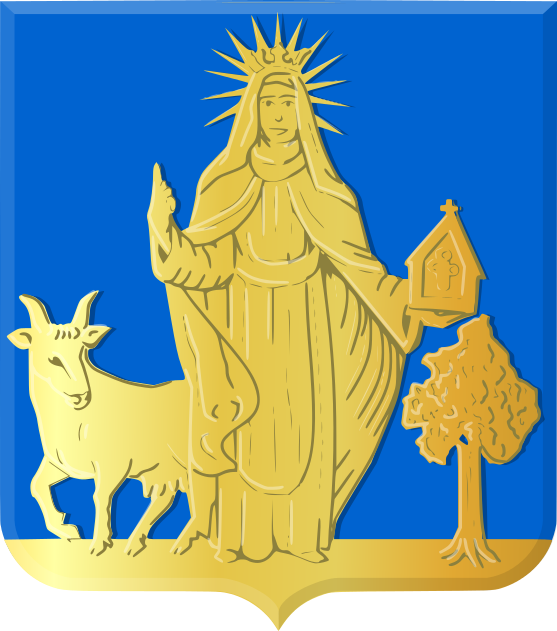
Wellen, Belgium (photo Catharina Eijs)
Story of St. Brigid
(From St Brigid’s GNS, Glasnevin, Dublin)
St. Brigid was born in AD 450 in Faughart, near Dundalk in Co. Louth. Her father, Dubhthach, was a pagan chieftain of Leinster and her mother, Broicsech, was a Christian. It was thought that Brigid’s mother was born in Portugal but was kidnapped by Irish pirates and brought to Ireland to work as a slave, just like St. Patrick was. Brigid’s father named her after one of the most powerful goddesses of the pagan religion – the goddess of fire, whose manifestations were song, craftsmanship, and poetry, which the Irish considered the flame of knowledge. He kept Brigid and her mother as slaves even though he was a wealthy man. Brigid spent her earlier life cooking, cleaning, washing and feeding the animals on her father’s farm.
She lived during the time of St.Patrick and was inspired by his preachings and she became a Christian. When Brigid turned eighteen, she stopped working for her father. Brigid’s father wanted her to find a husband but Brigid had decided that she would spend her life working for God by looking after poor, sick and elderly people. Legend says that she prayed that her beauty would be taken away from her so no one would seek her hand in marriage; her prayer was granted. Brigid’s charity angered her father because he thought she was being too generous to the poor. When she finally gave away his jewel-encrusted sword to a leper, her father realised that she would be best suited to the religious life.
Brigid finally got her wish and entered the convent. She received her veil from St. Macaille and made her vows to dedicate her life to God. Legend also says that Brigid regained her beauty after making her vows and that God made her more beautiful than ever. News of Brigid’s good works spread and soon many young girls from all over the country joined her in the convent. Brigid founded many convents all over Ireland; the most famous one was in Co. Kildare. It is said that this convent was built beside an oak tree where the town of Kildare now stands. Around 470 she also founded a double monastery, for nuns and monks, in Kildare. As Abbess of this foundation she wielded considerable power, but was a very wise and prudent superior. The Abbey of Kildare became one of the most prestigious monasteries in Ireland, and was famous throughout Christian Europe.
St. Brigid also founded a school of art, including metal work and illumination, over which St. Conleth presided. In the scriptorium of the monastery, the famous illuminated manuscript the Book of Kildare was created.
St. Brigid’s Cross: Making a St. Brigid’s cross is one of the traditional rituals in Ireland to celebrate the beginning of early spring, 1st February. The crosses are made of rushes that are pulled rather than cut. They are hung by the door and in the rafters to protect the house from fire and evil. According to tradition a new cross is made each St Brigid’s Day, and the old one is burned to keep fire from the house. Many homes have several crosses preserved in the ceiling the oldest blackened by many years of hearth fires. Some believe that keeping a cross in the ceiling or roof is a good way to preserve the home from fire which was always a major threat in houses with thatch and wood roofs. St. Brigid and her cross are linked together by the story that she wove this form of cross at the death bed of either her father or a pagan lord, who upon hearing what the cross meant, asked to be baptised.
One version goes as follows: “A pagan chieftain from the neighbourhood of Kildare was dying. Christians in his household sent for Brigid to talk to him about Christ. When she arrived the chieftain was raving. As it was impossible to instruct this delirious man, hopes for his conversion seemed doubtful. Brigid sat down at his bedside and began consoling him. As was customary, the dirt floor was strewn with rushes both for warmth and cleanliness. Brigid stooped down and started to weave them into a cross, fastening the points together. The sick man asked what she was doing. She began to explain the cross, and as she talked his delirium quieted and he questioned her with growing interest. Through her weaving, he converted and was baptised at the point of death. Since then the cross of rushes has been venerated in Ireland.”
St. Brigid died in AD 525 at the age of 75 and was buried in a tomb before the High Altar of her Abbey church. After some time, her remains were exhumed and transferred to Downpatrick to rest with the two other patron saints of Ireland, St. Patrick and St. Columcille. Her skull was extracted and brought to Lisbon, Portugal by two Irish noblemen, and it remains there to this day St. Brigid is the female patron saint of Ireland. She is also known as Muire na nGael or Mary of the Gael which means Our Lady of the Irish. Her feast day is the 1st of February which is the first day of Spring in Ireland.
St. Brigid’s Cloak: St. Brigid went to the King of Leinster to ask for land to build a convent. She told the king that the place where she stood was the perfect place for a convent. It was beside a forest where they could collect firewood. There was also a lake nearby that would provide water and the land was fertile. The king laughed at her and refused to give her any land. Brigid prayed to God and asked him to soften the king’s heart. Then she smiled at the king and said “will you give me as much land as my cloak will cover?” The king thought that she was joking and because Brigid’s cloak was so small he knew that it would only cover a very small piece of land. The king agreed and Brigid spread her cloak on the ground. She asked her four friends to hold a corner of the cloak and walk in opposite directions. The four friends walked north, south, east and west. The cloak grew immediately and began to cover many acres of land. The king was astonished and he realised that she had been blessed by God. The king fell to the ground and knelt before Brigid and promised her and her friends money, food and supplies. Soon afterwards, the king became a Christian and also started to help the poor. Brigid’s miracle of the cloak was the first of many miracles that she worked for the people of Ireland.
***************************************************************************
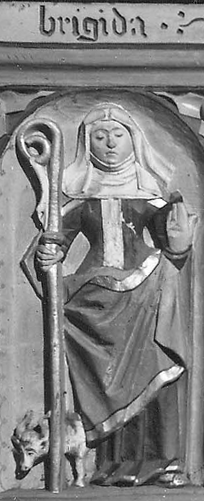
Wellen, Belgium (photo Catharina Eijs)
Another view of St Brigid:
St Brigid of Ireland
(abbreviated from www.newadvent.org/cathen/02784b.htm )
Born in 451 or 452 of princely ancestors at Faughart, near Dundalk, County Louth; d. 1 February, 525, at Kildare. Refusing many good offers of marriage, she became a nun and received the veil from St Macaille. With seven other virgins she settled for a time at the foot of Croghan Hill, but moved then to Druin Criadh, in the plains of the Liffey Valley, where under a large oak tree she erected her subsequently famous Convent of Cill-Dara, that is, “the church of the oak” (now Kildare), in the present county of that name.
The most ancient life of St Brigid is the metrical account by St Broccan, (d. 650). Then Cogitosus, a monk of Kildare, wrote the “Second Life” in the eighth century. An interesting feature of Cogitosus’s work is his description of the Cathedral of Kildare. The Round Tower of Kildare probably dates from the sixth century. Although St Brigid was “veiled” or received as a nun at Croghan, by St Macaille, it appears that she was professed by St Mel of Ardagh, who also conferred on her abbatial powers.
About the year 468 St Macaille and St Brigid followed St Mel from Ardagh into the country of Teffia that included portions of Meath, Westmeath and Longford. St Brigid’s small oratory at Cill-Dara became the centre of religion and learning, and developed into a cathedral city. She founded two monastic institutions, one for men, and the other for women, and appointed St Conleth as spiritual pastor of them. It has been frequently stated that she gave canonical jurisdiction to St Conleth, Bishop of Kildare, but, as Archbishop Healy points out, she simply “selected the person to whom the Church gave this jurisdiction”, and her biographer tells us distinctly that she chose St Conleth “to govern the church along with herself”. Thus, for centuries, Kildare was ruled by a double line of abbot-bishops and of abbesses, the Abbess of Kildare being regarded as superioress general of the convents in Ireland.
About the year 878, owing to the Scandinavian raids, the relics of St Brigid were taken to Downpatrick, where they were interred in the tomb of St Patrick and St Columba. The relics of the three saints were discovered in 1185, and on 9 June of the following year were solemnly translated to a suitable resting place in Downpatrick Cathedral. Various continental breviaries of the pre-Reformation period commemorate St Brigid, and her name is included in a litany in the Stowe Missal. In Ireland today, after 1500 years, the memory of “the Mary of the Gael” is as dear as ever to the Irish heart, and, as is well known, Brigid preponderates as a female Christian name. Moreover, hundreds of place-names in her honour are to be found all over the country, e.g. Kilbride, Brideswell, Tubberbride, Templebride, etc.
Viewing the biography of St Brigid from a critical standpoint we must allow a large margin for the vivid Celtic imagination and the glosses of medieval writers, but still the personality of the founder of Kildare stands out clearly. It seems certain that Faughart, associated with memories of Queen Maeve was the scene of her birth; and Faughart Church was founded by St Morienna in honour of St Brigid. The old well of St Brigid’s adjoining the ruined church is of the most venerable antiquity, and still attracts pilgrims; in the immediate vicinity is the ancient mote of Faughart.
*************************************************************************
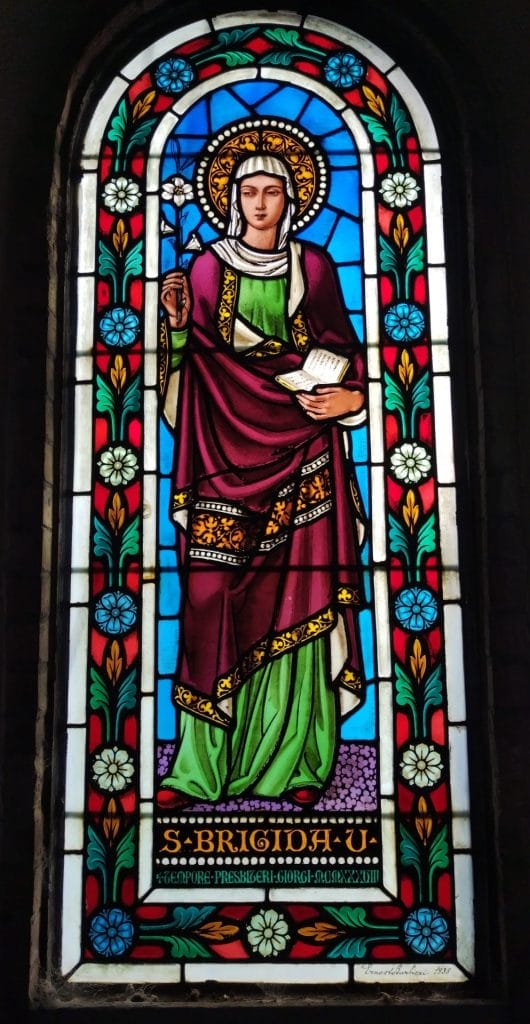
St Brigid, Santa Brigida Church, Italy (photo Bridget A Ryan)
How to make a St Brigid’s Cross:
https://scoil-bhride.com/how-to-make-a-st-brigids-cross
Crois crois Bríd ar mo chrios,
Muire is a mac, Bríd is a brat,
Más fearr atá sibh anocht
Go mba seacht fearr a bheidh sibh bliain ó anocht.
Rough literal translation:
Brigid’s cross on my belt,
Mary and her Son, Brigid and her cloak,
As well as you all are tonight
May you be seven times better this night next year.
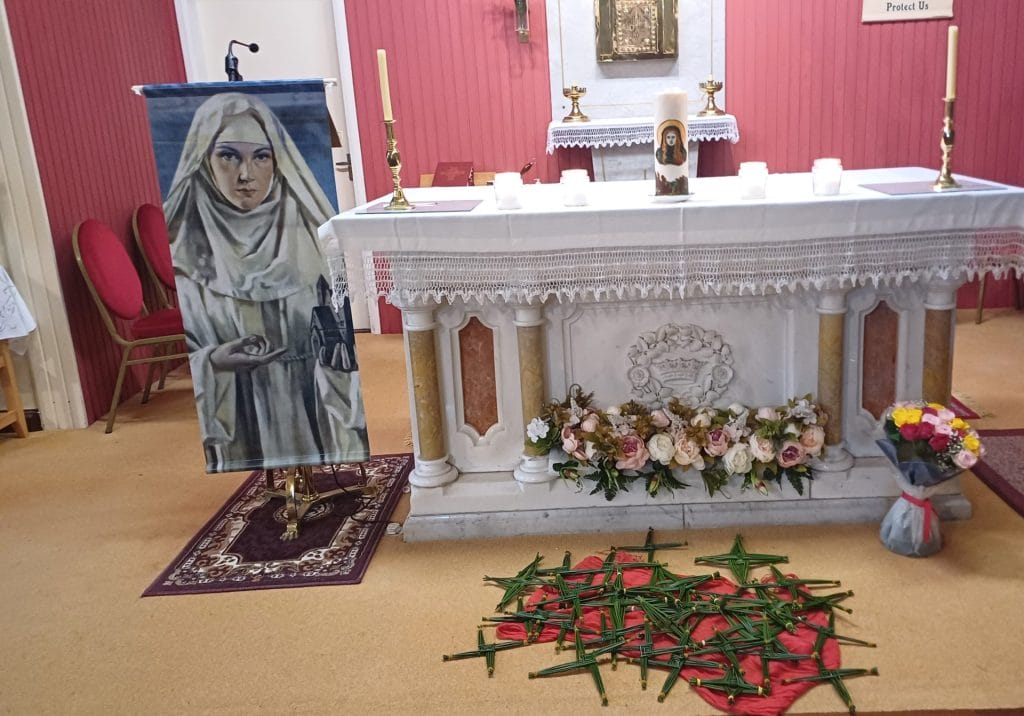
St Brigid Crosses, St Michael’s Church, Leenane, Co Galway (photo Breege Hyland)
*******************************************************************
Songs and Poems:
Brigid Buach is a new song which celebrates the multiple gifts of the most illustrious and much loved goddess/saint in the Irish tradition. Brigid is the patron of the arts, craft, healing, fire, alchemy, new life and spring and she heralds the new life of spring.
Composed by Pádraigín Ní Uallacháin from ancient lyrics, it is accompanied by Steve Cooney (bass guitar, acoustic guitars and percussion & vocals) and Dónal O’Connor (fiddle, keyboards, percussion & vocals). Brigid photo: Margaret Roddy. Produced by Dónal O’Connor in Red Box Studios.
Pádraigín says: “This song is at once ancient and new, and is released to raise Brigid’s healing spirit and ours, and to stir us into new energy as we move from one of the most turbulent times on earth to a springtime of new growth and awareness for humanity.”
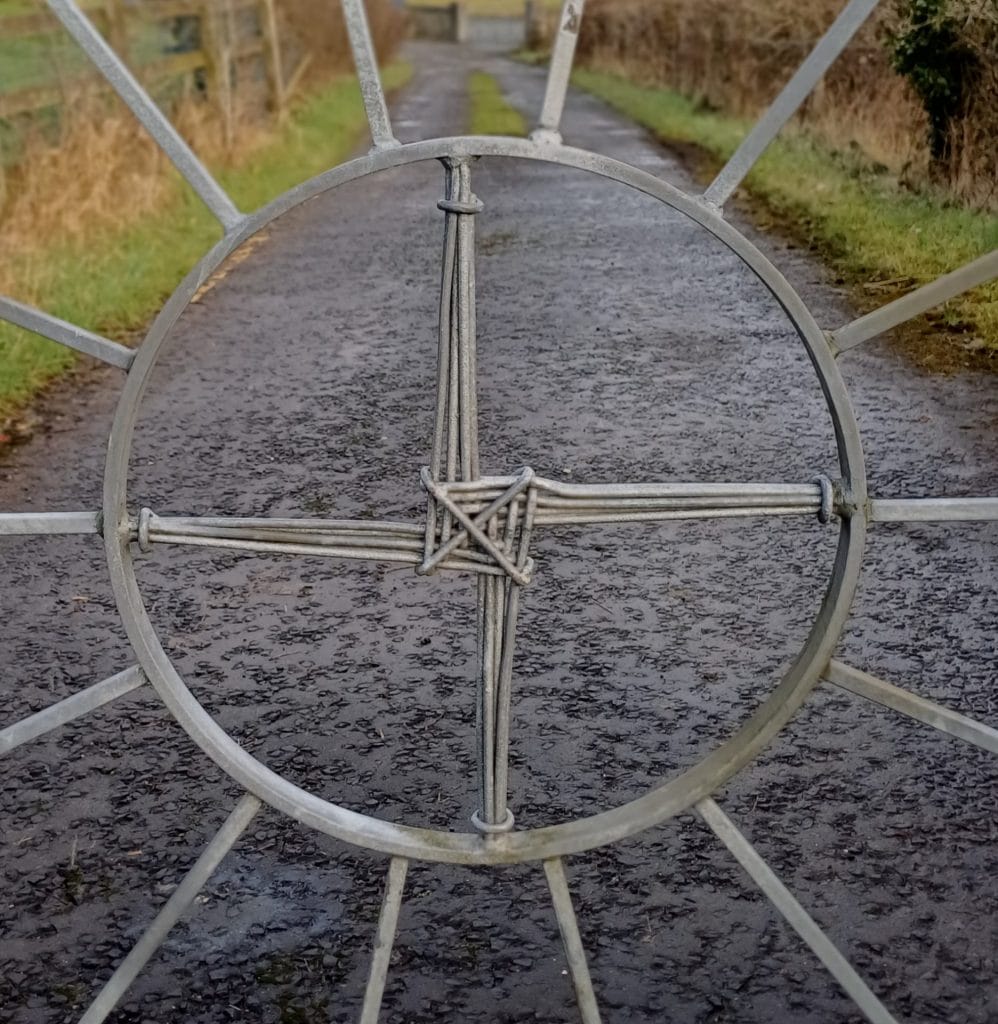
Kilbride Cemetery Entrance, Newport, Co Mayo (photo Breege Hyland)
Don’t Be Afraid Of The Light That Shines Within You: The inner spirit of this feast at the dawning of Spring is expressed in Luka Bloom’s lovely song for the feast of St. Brigid: Don’t Be Afraid Of The Light That Shines Within You:
Out of the cold, dark winter space
We come together, looking for Brigid’s grace.
We dip our open hands deep into the well..
Where our rivers run to
Who can tell, who can tell?
We warm our hearts and faces
In the heat of the burning flame.
Something about our spirit
Never stays the same.
Don’t be afraid of the light that shines within you
Don’t be afraid of the light that shines within you
Don’t be afraid of the light that shines within you
Within you
So many lives in shadows
With so much to give away,
Brilliant dreams in waiting
To see the light of day.
We step up to the well
At the dawn of springtime
And when we go our way
We let the light shine..
Let your light shine
Let the light protect you
~ Don’t be afraid of the light that shines within you…
Let the light direct you
~ Don’t be afraid of the light that shines within you…
Don’t be afraid
~ Don’t be afraid of the light that shines within you…
The light that shines within you
Dept of Foreign Affairs Commission: Three poems, commissioned by the Dept of Foreign Affairs and the Museum of Literature, to honour St Brigid’s Day, for its inaugural Bank Holiday on 1 Feb 2023.
Old Biddy Talk
By Paula Meehan
Have you no home to go to…
The young mostly on one another’s screens
– but these two rapt in each other
at the boundary wall: that genetic imperative,
the force that through the pandemic
drives their flowering, is my spring rain,
is my restorer from the deep delved wells,
hauled to the healing light of this world
pure water tasting of gemstone & iron,
quartzite & gold:
starlight & planets,
the sun & the comets, the moon herself,
she sacred to Brigit, mirrored in my bucket.
My own breath, old spirit, stirring in the cowled
reflection of the earth geologic, old seas,
old forests wherein once we swung from tree
to waterlogged tree become shale, become coal,
underground tributaries to rivers of oil –
breath lit fuel in their veins. They are fire –
vestal and flame. They are immortal.
At Bridget’s Well
By Doireann Ní Ghríofa
When rain fell on a path of stone,
one by one, we appeared alone.
Each of us wore a different face,
but we were all the same –
drawn by ache to lift green latches,
drawn by want to walk the dark
passage. Past paper stares, we knelt
and wept, we who fed the well in rivulets,
whose plunged wrists trembled
with vessels of blue violets.
We each spoke a spell of stone
and in her gloom heard prayers turn poems.
Ask her, Bríd, what will be
come of us?
Listen. Liquid, the syllables;
the echo, luminous.
i mbolc
an invocation
By Nidhi Zak/Aria Eipe
guardian of the fawn
brightest of the flame
awaken us at dawn o
exalted! hear your name
come glinting in the hearth
kohl lashes lined with soot
steel flint omega arches
fleet mare so light of foot
milk flecked o’er the mouth
skin tight sweet lipped foam
suckled at the reddening
ears, corners of your cloak
glistening by a winch above
the veiled amnion of well
hold us, head neath water,
that we might breathe again
stay winter: light the torch
in dark where life is forged
in the belly; draw breath —
draw rein
***********************************************************************
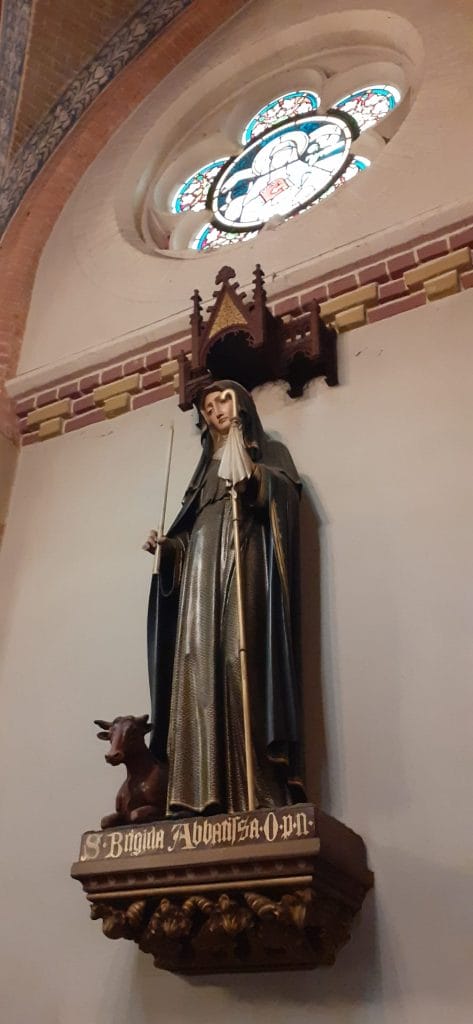
Bavel Church, Germany (photo Barbara Brosch)
Resources for Schools:
https://www.seomraranga.com/2015/01/resources-for-st-brigids-day/ (includes Power Point link as Gaeilge)
https://www.cspn.ie/lnews/zgf5jeu1qtpfwrx8ff2a9glddm8caw
https://www.kandle.ie/wp-content/uploads/2021/01/St-Brigid-4th-Class.pdf
https://www.spiritofbrigid.ie/wp-content/uploads/2025/10/Resources-for-Teachers.pdf (contains numerous links)
the english language version is here https://www.catholicbishops.ie/2022/01/31/feast-of-saint-brigid/
Thanks for all these resources on Brigid on this site – scant elsewhere.
I get a sense that the State is doing more to promote St. Brigid albeit its emphasis on the Monday Bank Holiday, than the Irish Church. It seems like a lost opportunity by the Church to celebrate all the strong women (Brigids) in our lives and in our parishes. Also a lost opportunity to promote something that is very central to Brigid and the Gospel – Hospitality/ making room for others.
I recommend Nancy Fitzgerald’s book Brigid’s Mantle, Finding the Fiery Saint Of Kildare at the Heart of Celtic Spirituality (Paulist Press 2025). From Saturday 31st January to February 7th Nancy will be giving a series of talks around the country.
https://www.nancyfitzgeraldauthor.com/events
It’s hard to do more than project one’s fantasies onto a saint if there is no documentation, which is not the case with St Patrick whose voice comes to us so clearly through his writings. I asked ChatGPT for the documentation on St Brigid and this is what I learned:
Vita Sanctae Brigitae, written no later than the 7th century by Cogitosus, a monk of Kildare. It blends story, miracle accounts, and descriptions of the Kildare monastery.
Bethu Brigte: An Old Irish prose life of the saint composed around the 9th century.
Two early hymns — one by St Ultan of Ardbraccan and one by St Broccán — date from around the 7th century and celebrate Brigid’s sanctity.
Acta Triadis Thaumaturgae (Acts of the Wonder-Working Triad). A 17th-century compilation by John Colgan that collects lives and legends of St Patrick, Brigid, and Columba from older manuscripts.
Noel Kissane’s Saint Brigid of Kildare: Life, Legend and Cult (Four Courts Press) is a modern academic study examining her life, the development of her cult, and the traditions around her.
Medieval Irish annals and martyrologies record Brigid’s feast day (February 1) and sometimes link her life to contemporary ecclesiastical figures.
Medieval breviaries (like the Breviarium Aberdonense) include offices and readings for her feast, preserving legendary material.
There’s ongoing scholarly discussion about distinguishing the historical Brigid from legendary material and assessing later interpolations and folklore influences.