
Vatican News: Synod releases final reports on selection of bishops, emerging issues
The General Secretariat of the Synod publishes the first part of the Final Report of Study Group No.7, regarding criteria for selecting candidates for the episcopate, and the Report of Study Group No. 9, on theological criteria and synodal methodologies for discerning doctrinal, pastoral, and ethical questions.
By Antonella Palermo
The Final Reports of Study Groups No. 7 & 9 reaffirm that discernment lies at the heart of selecting a bishop, while adopting specific theological criteria to discern how to address the most difficult questions facing the Church, according to Cardinal Mario Grech, Secretary General of the General Secretariat of the Synod of Bishops.
As reflection continues on the judicial function of the bishop, ad limina apostolorum visits, and the formation of bishops, the preliminary part of the Final Report on the criteria for selecting bishops has been released.
The report reaffirms the underlying premise that there is no shepherd without a flock, and no flock without a shepherd.
The synodal competencies identified by Study Group No. 7 for candidates include the ability to build communion, engage in dialogue, possess deep knowledge of local cultures, and show a willingness to integrate into them constructively.
The group calls for Apostolic Nuncios to have “a synodal and missionary profile,” so that he may also look for this profile in those proposed as possible bishops.
The report states that every diocese should periodically carry out processes of discernment regarding its situation and needs, verifying whether those processes meet the standards of a synodal and missionary Church, in order to promote the sharing of best practices.
“As an episcopal succession approaches, the Bishop is to convene the Presbyteral Council and the Diocesan Pastoral Council, whose members express, in a collegial manner, an opinion on the needs of the diocese and submit to the Bishop – in a sealed envelope – the names of priests they consider suitable for the episcopate,” it says. “Where possible, consultation is also to include the Cathedral Chapter, the Finance Council, the Lay Council, and representatives of consecrated persons, young people and the poor.”
Involvement of consecrated persons and laypeople in consultations
The Study Group encourages what it describes as “a formative investment,” aimed at helping all members of the People of God sharpen their capacity for discernment.
It proposes creating dedicated teams to assist the bishop in the ongoing formation of the clergy.
In cases where a local see is vacant, the group suggests that a committee be established in the diocese, which the Nuncio may consult in order to clarify the state of the diocese, the profile of the new shepherd, and possible candidates.
The Group recommends that consultations involve not only clerics, but also, as far as possible, an equivalent number of consecrated men and women, laymen and laywomen. The aim, it explains, is to bring out the truth as fully as possible.
The Report also asks the Dicasteries of the Roman Curia to review their procedures in a more synodal direction and proposes periodic forms of independent evaluation of selection processes.
Linguistic and methodological paradigm shift
The Final Report of Study Group No. 9 draws on the biblical image found in chapters 10–15 of the Acts of the Apostles, which shows how cultural diversity can be valued without betraying the newness of the Gospel.
It proposes a change of paradigm in the way the Church addresses the most difficult doctrinal, pastoral, and ethical questions.
First, the report prefers the adjective “emerging” rather than “controversial” to describe these questions.
The statement explains that “the aim is not merely to resolve problems but to build the common good through relational conversion, shared learning and transparency.”
In addition, since there can be no proclamation of the Gospel without taking responsibility for the interlocutor, “in whom the Spirit is already at work,” the document introduces the “principle of pastorality.”
The report identifies three methodological steps for addressing these questions: listening to ourselves, listening to reality, and convening different forms of knowledge.
Conversation in the Spirit, it recalls, remains the privileged tool for developing an ecclesial culture of synodality.
Concrete testimonies as basis for discernment
The report calls for these guidelines to be applied concretely to the experience of homosexual Catholics and the practice of active nonviolence.
With regard to forms of nonviolence in particular, the group was guided by the testimony of a movement of young Serbs who contributed to the peaceful fall of Milošević, drawing inspiration from the Christians of the early Church.
In both cases, testimony serves as the starting point for paths of ethical and theological discernment, as well as for open questions, so that every community may take up “the responsibility of recognising and promoting the good through which God acts in history and in people’s experience.”
************************
The selection of bishops and the handling of emerging doctrinal, pastoral and ethical questions
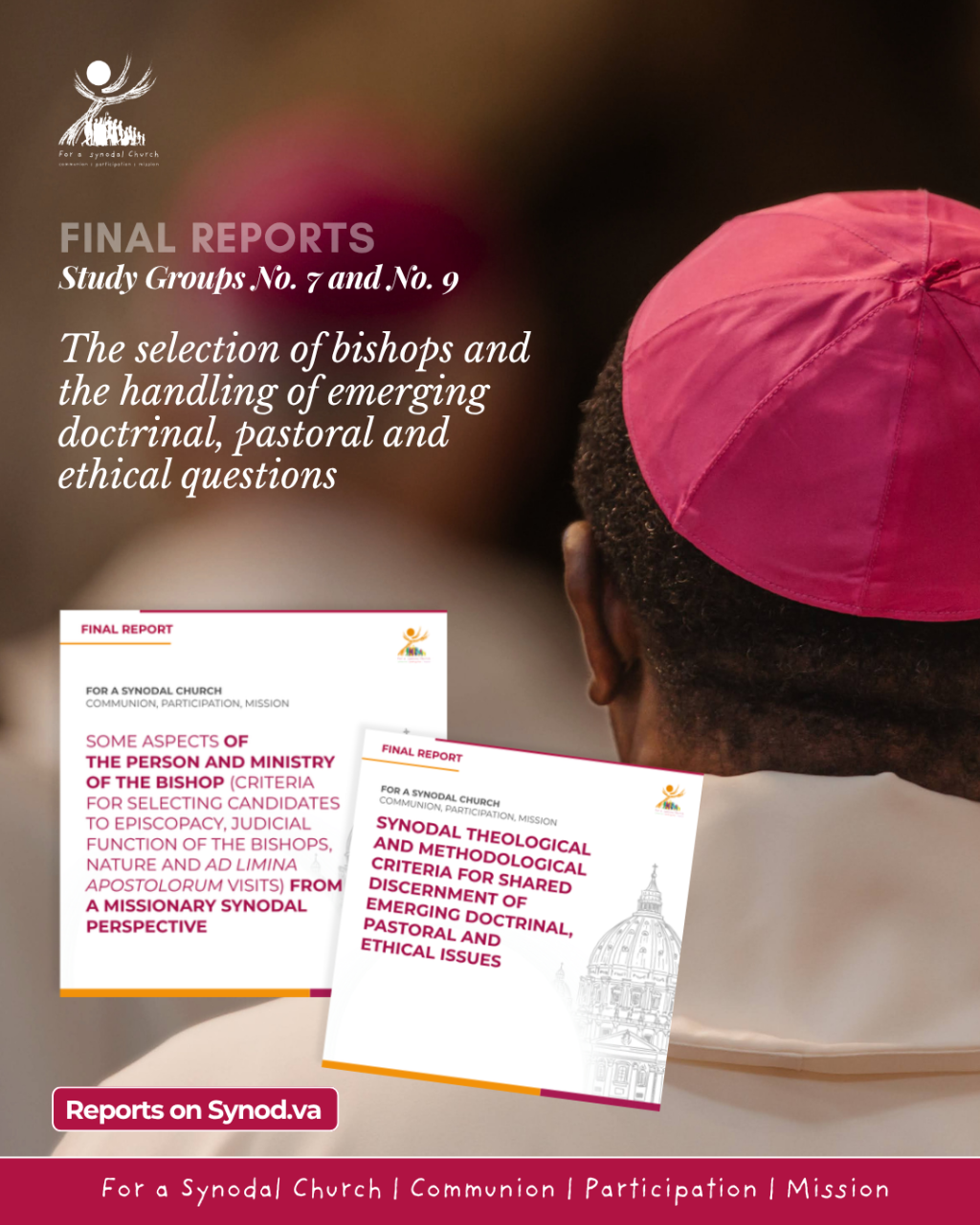
Publication of the Final Reports of Study Groups No. 7 and No. 9
https://www.synod.va/en/news/the-selection-of-bishops-and-the-handling-of-emerging-doctrinal.html
Vatican, 5 May 2026
The General Secretariat of the Synod today publishes the first part – concerning the criteria for the selection of candidates to the episcopacy – of the Final Report of Study Group No. 7 on Some aspects of the person and ministry of the Bishop (in particular: criteria for selecting candidates to the episcopacy, the judicial function of the Bishops, the nature and structure of ad limina Apostolorum visits) from a missionary synodal perspective, together with the Final Report of Study Group No. 9 on Theological criteria and synodal methodologies for shared discernment of emerging doctrinal, pastoral, and ethical issues.
“These two reports touch the very heart of ecclesial life. The first reminds us that the selection of a bishop is a moment of authentic discernment for the Christian community: there is no shepherd without a flock, nor a flock without a shepherd. The second offers concrete tools for addressing the most difficult questions without fleeing from complexity: listening to those concerned, reading reality, and bringing together different forms of knowledge. It is the synodal method applied to the most demanding situations,” affirms Cardinal Mario Grech, Secretary General of the Synod.
The First Part of the Final Report of Study Group No. 7
The First Part of the Final Report of Study Group No. 7 presents the selection of candidates to the episcopacy as a moment of authentic ecclesial discernment, guided by the Holy Spirit in a climate of prayer and listening. The subjects involved include the local Church with its Bishop, the Bishops of the Ecclesiastical Province or of the Episcopal Conference, and the Apostolic Nuncio – whom the Group considers it important to possess a synodal and missionary profile, so as to seek the same in those proposed as possible Bishops.
The document proposes that each diocese periodically activate processes of discernment regarding its own situation and needs. As an episcopal succession approaches, the Bishop is to convene the Presbyteral Council and the Diocesan Pastoral Council, whose members express, in a collegial manner, an opinion on the needs of the diocese and submit to the Bishop – in a sealed envelope – the names of priests they consider suitable for the episcopate. Where possible, consultation is also to include the Cathedral Chapter, the Finance Council, the Lay Council, and representatives of consecrated persons, young people and the poor.
Among the qualities required of candidates, the Group highlights “synodal competencies”: the ability to build communion, the practice of dialogue, a profound knowledge of local cultures, and the willingness to integrate into them in a constructive manner. The Report further calls upon the Dicasteries of the Roman Curia to review their procedures in a more synodal direction and proposes periodic forms of independent evaluation of the selection processes.
The Group continues its reflection on the other themes entrusted to it: the judicial function of the bishop, the ad limina Apostolorum visits, and the formation of bishops.
Final Report of Study Group No. 9
The Final Report of Study Group No. 9 proposes a paradigm shift in the way the Church approaches the most difficult doctrinal, pastoral and ethical questions. Its starting point is a biblical icon: chapters 10-15 of the Acts of the Apostles, which show how cultural diversity can be valued without betraying the newness of the Gospel.
A first significant choice concerns terminology: the Group has preferred to speak of “emerging” rather than “controversial” questions, since the aim is not merely to resolve problems but to build the common good through relational conversion, shared learning and transparency.
The document introduces the “principle of pastorality”: there is no proclamation of the Gospel without taking responsibility for the interlocutor, in whom the Spirit is already at work. In addressing emerging questions concretely, the Group proposes three methodological steps: listening to ourselves, paying attention to reality, and summoning various forms of expertise. Conversation in the Spirit remains the privileged instrument for developing an ecclesial culture of synodality.
In the third part of the Report, the Group applies this method concretely to two questions that are currently emerging in the life of local Churches, chosen precisely for their diversity: the experience of homosexual persons who are believers, and the experience of active non-violence – witnessed by a movement of Serbian youth that contributed to the peaceful fall of Milošević, drawing inspiration from the early Christians. In both cases, the Group does not offer definitive pronouncements but – beginning from the direct listening to concrete testimonies – proposes paths for ethical-theological discernment and open questions, so that each community may assume “the responsibility of recognising and promoting the good through which God acts in history and in people’s experience.”
——