Auxiliary Bishop Ludger Schepers of Essen at the German Catholic Congress
Colm Holmes, We Are Church, was at the German Catholic Congress in Würzburg 13-17 May 2026.
He writes: One of the presentations was by Auxiliary Bishop Ludger Schepers of Essen who spoke strongly in favour of full equality for women in the Catholic church.
Attached below is an English translation:
The spoken word takes precedence.
Speech manuscript
Auxiliary Bishop Ludger Schepers
Stand up for women’s rights: The denied vocation – A plea for full Justice
I. A new beginning: No more excuses
I know that many of you are tired of hearing this phrase:
‘The role of women is a central concern of our Church.’
For in recent decades, this phrase has become a rhetorical sedative, whilst in reality hardly anything has changed in the rigid power structures.
I stand before you today as a bishop at this Catholic Day because I sense the deep alienation that pervades our halls here, our Church, our society. We must stop pretending that we need even more working groups or theological reports. We do not have a problem of understanding. We have a problem of implementation. When we speak today of women’s rights in the Church, we are speaking of the viability of Catholicism in a free society. Anyone who denies women full participation in ministries, ordination and decision-making undermines the sacramental credibility of the Church at its very roots.
II. Official Documents: The Architecture of Exclusion
Let us take an unbiased look at our documents. The Second Vatican Council gave us in Gaudium et Spes (Art. 29) a clear task: All discrimination based on sex must be overcome as “contrary to God’s plan.” This has been stated there since 1965.
But let us look at current canon law: The Codex Iuris Canonici still functions as a bulwark of clerical privileges.
• The Monopoly of Power: As long as the “final decision-making power” (can. 129 §1) remains exclusively tied to male ordination, any promotion of women in the Church is merely “participation on demand.”
• The Statistics Trap: The latest figures from the German Bishops’ Conference (March 2025) do show an increase in women in leadership positions to 32.5%. But as a member of the Women’s Commission, I tell you: statistics are not justice. A woman who heads a diocese but has no sacramentally secured vote in theological or disciplinary decisions remains structurally inferior. We are legally cementing a “doctrine of inequality” that we can no longer afford theologically.
III. Theological Depth: God Became Human, Not Male
The theological resistance to women’s ordination often rests on an argument that the dogmatic theologian Julia Knop aptly describes as “sacramental biologism.” It is claimed that the priest must be a man to make the “masculinity of Jesus” visible.
To this I say: This is a dangerous oversimplification of the event of salvation.
1. Anthropology of Wholeness: If we claim that only the male body can represent Christ, we are de facto declaring women incapable of fully reflecting the image of God. This contradicts the biblical truth of Genesis 1:27. Women are not “less capable of Christ.” God became human, not merely male.
2. Sin Against the Spirit: The theologian Johanna Rahner speaks of a systemic “forgetfulness of the Spirit.” When women feel an authentic calling and we reject them uncritically because of their gender, we as an institution claim to know better than the Holy Spirit. This is a form of hubris that we can no longer afford.
3. The Apostle to the Apostles: Mary Magdalene was not a silent helper. She was the first proclaimer of the Resurrection. A Church that celebrates Mary Magdalene but forbids her female successors from speaking at the altar is acting against its own founding story (Apostle Junia).
IV. Sociological Analysis: The Price of Exclusion
From a sociological perspective, the Church is currently undergoing a kind of “identity retreat.”
• The exodus of women who carry meaning: The latest data from the Church Membership Survey (CMS) is a warning sign. We are currently losing women under 50 on a massive scale. These are the women who used to provide religious socialization within families. When they leave, the social foundation of our Church collapses. They are not leaving because they no longer believe, but because they can no longer maintain their integrity within a discriminatory structure.
• Abuse of power and homogeneity: The MHG study and its successors have demonstrated that purely male, celibate power circles are susceptible to abuse of power and cover-ups. The full integration of women into leadership positions is not a matter of courtesy, but a vital measure for the separation of powers. We need correction by women as equal decision-makers with their own right to vote – not as “maternal accessories”.
V. Concluding Remarks: The Hour of Truth
This Catholic Congress is marked by a new beginning. But a new beginning means conversion – metanoia.
I am not calling for adaptation to a fleeting spirit of the age. We are calling for a return to the radical nature of the Gospel, which knows no privilege. As a bishop, I say to you: The Catholic Church will only have a future if it stops sorting God’s gifts according to gender.
We must liberate the ordained ministry from male exclusivity in order to reclaim it as a service to the unity of all the baptized. Justice is not a topic for the next synodal report. Justice is the litmus test for the seriousness of our faith.
Let us stand up together – for a Church that finally becomes what it is meant to be: A community of brothers and sisters of equals. Now.
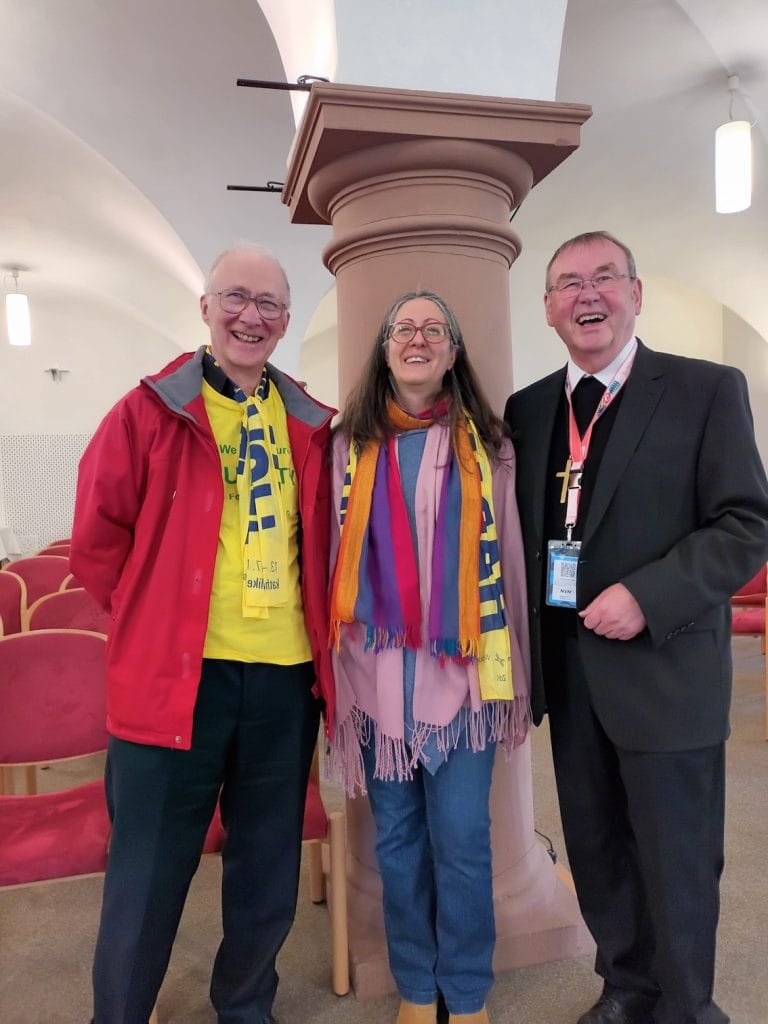
Colm Holmes (WAC International & Ireland); Elza Ferrario (WAC Italy)); Auxiliary Bishop Ludger Schepers
What a breath of fresh air! What enlightenment has the endless argumentation against female ordination produced? It has given voice to a vast web of anxieties — the dread of change, of the other, the status anxiety Sean O’Conaill talked of and of which the Book of Genesis offers masterful analyses — the dread that ‘women will take over’ and that ‘the church will lose her bridal structure’ and ‘the priest will no longer be able to represent Christ the Bridegroom,’ the dread that female ordination will cause a schism. Yet all that need be done is cede to common sense, let the texture of modern society replace our creaky Tridentine clericalism, and imitate the solutions found in the other Christian churches, which do not spend all their time ululating about their own decline. Or to put it in other words: Do not quench the Spirit!
The tale persists, for a reason, that Paul VI was to say Mass on the Monday after Pentecost Sunday in 1970 and was surprised to find no red vestments and no sign of the Sequence ‘Veni sancte Spiritus.’ ‘What happened to the Octave?’ he asked. ‘It was abolished, Your Holiness.’ ‘Who abolished it?’ ‘You did, Your Holiness.’ The Pope wept. To make up for this loss I decided to recite the third glorious mystery in place of all the other mysteries of the Rosary this week and next.
” Anyone who denies women full participation in ministries, ordination and decision-making undermines the sacramental credibility of the Church at its very roots.”
This German bishop can say it as is. Any courageous Irish bishop/s to finally drop the endless meaningless plámás and speak (and act) with parrhesia?
https://www.facebook.com/reel/1629356808286569 (The speaker is an Old Catholic.)