Jim Cogley’s Reflections: Tues 2 Sept – Mon 8 Sept 2025
HEALING AND AWARENESS, A SPIRITUALITY OF INTEGRATION AND WHOLENESS. This will be the theme for a retreat in Ballyvalloo Conference Centre, Co. Wexford, which will be led by Fr. Jim Cogley and Luba Rodzhuk. Beginning 6pm Tue 30th Sept to Friday Oct 3rd. There are just a few places still available. If you have already attended a one day seminar this will be an ideal opportunity to deepen the experience.
Contact Breda Costello, 34 Melitta Park, Kildare Town, R51YV48 , or email her at – breda.costello@icloud.com or ring her on 087- 6128253.
Pilgrimage News: Sunday next Bishop Ger Nash will dedicate the Wall Mural and Remembrance Garden which will be a facility for those who wish to have a loved one remembered on a ceramic photo. The wonderful singer Michael Flood from Gorey will sing at the 3pm Mass and the dedication. The Close of the Pilgrimage will be on Mon 8th with Mass at 7pm followed by a torchlight procession
Tues Sept 2nd – A World of Symbols
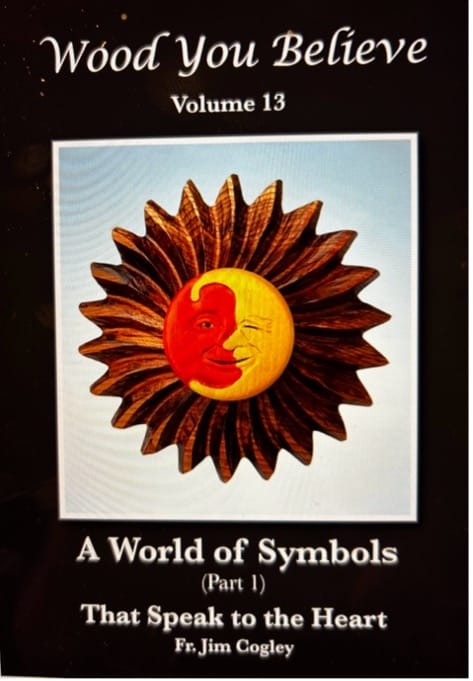
Above is the cover page of a book that was launched by the soprano singer Celine Byrne at a Pilgrimage gathering on August 24th in Lady’s Island. It has just been made available for sale on the website jimcogley.com so for those who receive these postings and would like a copy I will say something about the book and give a flavour of the contents. Last year the book launched was When I Loved Myself and that really struck a chord in so many with over 3000 copies sold and now into its second print run. As you may know I have been making symbols in wood for nearly twenty-five years and now have quite a collection. All serve just one purpose: to integrate in a visual manner the human and spiritual journey and to show them as being one and the same. The overall title for all books in the series is Wood You Believe. ‘You’ represents the human journey and ‘believe’ the spiritual quest, and they are both integrated through the medium of the ‘wood’ symbols.
Wed Sept 3rd – Background to Books
Following a whisper of Spirit around the turn of the Millennium that simply said, ‘Go to the Wood’, I began a fascinating adventure into completely unknown territory of working with wood, first with woodturning, then later with carving and other related disciplines like fretwork, miniature work, tool-making and the use of colour. I quickly began to appreciate the effect of using these creations in seminars and presentations. The power of the visual symbol opened a door of understanding for so many who never before even knew that this had always been their primary way of learning. There followed many requests to commit the contents of seminars to paper. Previous to this I had never considered writing and would have felt inadequate in that area. Now twenty-five years later that work had taken on a life of its own, as did the woodcraft, and there are fourteen, quite varied, productions in the Wood You Believe series.
Thurs Sept 4th – Sun & Moon

The cover photo for Vol 13 depicts the Sun and Moon in a pose of contented harmony. The Sun is the ultimate source and reflects its warmth like unconditional love that keeps on giving and never asks for anything in return. It is always happy to share its light and energy. The Moon has no energy or light source in itself, but it can reflect the light as it revolves around the Sun and is held in space, like the Earth, by its gravitational pull. By remaining in alignment with its source, the Moon reflects the light of the Sun even while the Earth is shrouded in darkness. Night after night, in varying degrees, the miracle repeats itself. Even while one side of the Earth is hidden to the Sun, it still enjoys its light thanks to the Moon. This is how it is with wise souls who by recognizing their emptiness and powerlessness live in divine alignment with their true source and so can offer light, hope and direction to a world that is not yet ready to face in the right direction.
Fri Sept 5th – Who Pulls My Strings?
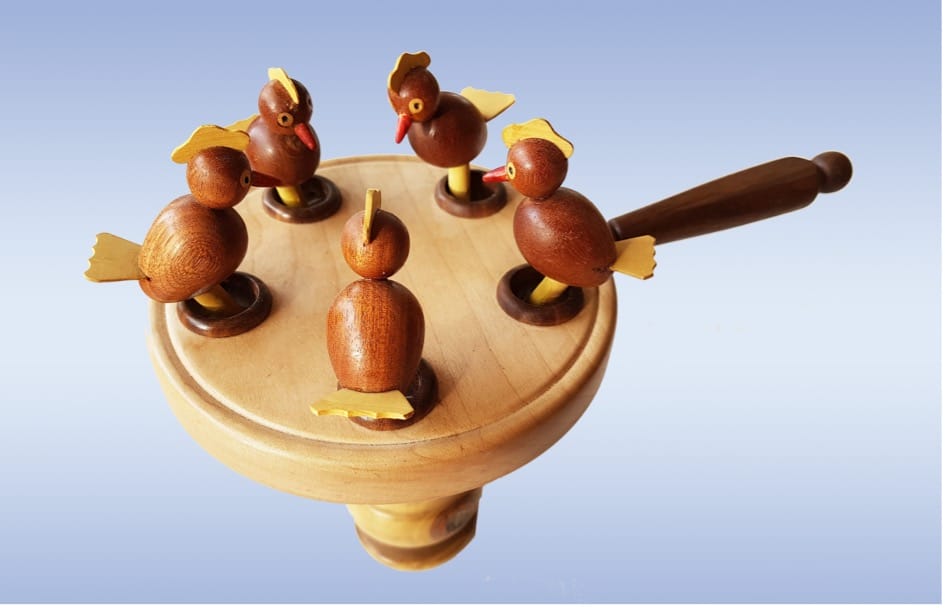
The Pecking Order
The photo shows a replica of an old Victorian toy. Versions of these are still being made and are often for sale in craft shops. It is a very dynamic piece where the five chickens are all connected by strings underneath to a ball that moves at the will of the person holding the handle. As the handle is moved, all sorts of amusing interactions between the five chickens take place; one can be made to stand aloof while another is made to look greedy and so on. As such they can represent the pecking order in our family of origin that tends to replicate itself in later life. The one who had no voice may continue to be silent; the controller remains in control; the scapegoat continues to feel blamed for everything. We carry the complex interactions and roles adopted in earlier life into adult life and, until we consciously master them, we will be unconsciously forced to repeat them. Some of these could include, being the responsible one; being the carer; being the fixer; the intellectual one who stands aloof or the scapegoat who can never get anything right, and who gets blamed for everything.
Sat Sept 6th – Emotional Lockdown
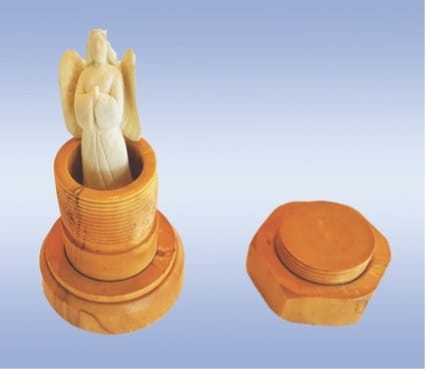
The Angel of Surprise
Lockdown is a term we became very familiar with during the Covid pandemic. Yet its practice always was and always will be happening. What initially appears to be just a nut and bolt made of wood, when unscrewed reveals a hidden surprise. The bolt is also a box that contains a little angel that has some unusual properties. If placed in a glass of water it will, over a few days, expand to almost fill the space it is given. This carries a profound symbolic message in relation to all the issues that we so easily put into lockdown: the rejections and betrayals; the hurts and disappointments; childhood memories and adult disasters. So many of these get put out of sight and are repressed in the cellar of the unconscious. We think that once out of sight they are safe while in fact they begin to wage a guerrilla war against us and sabotage our lives in myriad ways. If opened up with courage, that painful emotion or difficult issue begins to take on the characteristic of the angel. It becomes a benign influence and spreads its wings of blessing into every area of our lives. It is from our wounds, to which we have brought healing, that the greatest blessings flow.
Sun Sept 7th – Hating Father and Mother
As we come to the close of this year’s pilgrimage season, I’m going to take my cue from the Gospel and share a few thoughts about the pilgrimage of being a parent.
When we reflect on some of the sayings of Christ it’s no wonder that had him crucified. There were many that were nothing short of outlandish. Like that one today where he says, ‘No one can be my follower unless he hates his father and mother’. The Jewish culture was built on family loyalties and respect towards parents was paramount. Any self-respecting Jew must have felt like throwing stones at Jesus when he apparently reversed the fourth commandment, honour your father and your mother, by saying you must hate them.
So, what did Jesus really mean when he used those words. Imagine if your son or daughter said in a fit of rage, ‘Mum I really hate you’ and tell you in colourful language to butt out of their life. So many know what’s that’s like and its far from pleasant. Your self-esteem drops to zero, you feel like you’ve been a terrible parent who has failed miserably, and you want to beat yourself up.
Looked at from a Gospel perspective such a teenage outburst can be seen very differently. Every parent would like their child to grow up courteous, respectful and ideally not to cause them too much hassle. Yet strange to say it’s often the very ones who grew up never causing a day’s bother can be the very ones who don’t do as well as the ones who broke their parents’ hearts.
Why is it that the profile of so many troubled young adults is that of ones who never caused a moment’s grief to their parents. They often say, ‘I don’t know who I am, I have no sense of my own identity, I feel lost lonely and confused.’
Could there be a strong connection between lack of identity and never having separated from parents? So many psychological studies have shown that there is, which only serve to back up the significance of what Jesus said two thousand years before Psychology was even heard of, that in order to become a disciple a person must hate father and mother. Becoming a disciple could be understood as finding freedom, coming to maturity and becoming one’s own person.
Many parents do for their children what they are big and ugly enough to do for themselves. The problem is that dependent children find it difficult to grow up and depend on themselves. Also, in a very subtle manner the over caring parent is holding onto his or her role as parent and not allowing themselves the freedom to be anything other than parent.
There’s a wonderful saying that expresses this very well: Selfhood begins in the going away and love is proved in the letting go. In taking on the role of parent a lot of your identity as a person becomes overshadowed since the task is just so demanding. But there comes a time when you must throw the reins on the ass’s back and let them off. The parent who is over-possessive always stands the risk of destroying what he or she treasures most, namely the love and affection of their child.
When it comes to letting go and children taking on their own identity, nature has a lot to teach us. The magnificent eagle takes great care to build a wonderful nest high on a cliff face. There the young are cared for; they feast on morsels brought by devoted parents and their every need is provided for. Often there’s just one chick who is both special and spoilt. There comes a day when the young one looks on in bewilderment as the mother eagle dismantles the lovely home and pushes it over the cliff. She then encourages the eaglet to take flight. Leaving the only security the offspring has ever known is a daunting task and the mother usually encounters resistance. So, she encourages it with a not so gentle push. Generally, the young one falls rather than flies and may keep its wings closed in fear in which case the mother swoops down and catches the offspring on her broad back and repeats the exercise. Eventually the bird is ready, it looks to the Sun, its wings open wide, and it is ready to soar and surf the air currents. It’s so easy for a parent to so mollycoddle a young person to the point where they forget they were born to fly.
There is a point where the eaglet must hate the parent for what they are doing but shortly after will love them for what they have done. Would that more parents learn the message of the eagle and realize that when their children seem to hate them, they are most ready to take flight. Selfhood begins in the going away and love is proved in the letting go. It’s an essential part of the pilgrimage of being a parent.
Mon Sept 8th – Untying the Knots
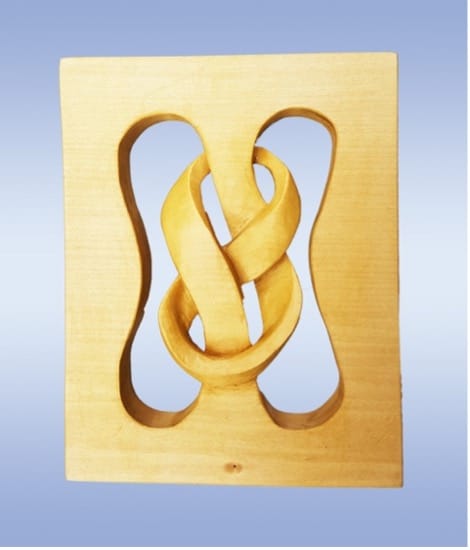
The piece of sculpture shown can point to some of the big blows in life that are very difficult to accept. Deep personal hurts like abuse, betrayal, divorce or the death of a loved one can, and usually do, leave a knot that can be very complex and difficult to unravel. The piece is also a portal that is partially blocked by the knot, suggesting that our life energy is impeded and unable to flow freely until the knot is untied. Many will say that their life has never been the same, or that they have never felt right, since a certain event happened. It’s as if much of life has stopped back there, and ever since it’s been just an existence. In order to heal we need to remember that without feeling there can be no healing. We usually try to avoid everything that is painful in a myriad of different ways. We get busy, pick up our phone, call a friend, comfort eat or drink too much. Many will seek medication to numb the intensity of the pain. In so doing we are simply repressing our feelings, and thus ensuring that they will persist. It is only by befriending those difficult emotions that they will change to something positive. Sadness will give birth to compassion, loneliness to solitude. Even the troublesome emotion of anger will give way to creativity. The secret is to practise inner hospitality and sit with that difficult feeling, without becoming identified with it, and to do so long enough for it to reveal its positive side.