Vatican News: St John Henry Newman set to become newest Doctor of the Church (plus reflection by Joe O’Leary)
Pope Leo paves the way for St John Henry Newman to be formally declared a “Doctor of the Church”.
By Alessandro De Carolis
Link to article:
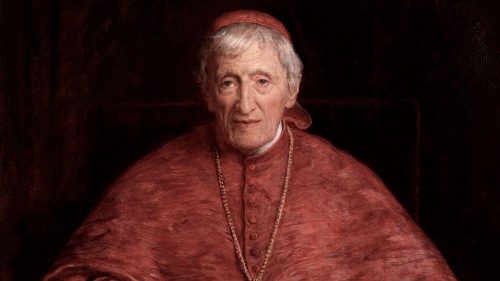
One of the great modern thinkers of Christianity, a key figure in a spiritual and human journey that left a profound mark on the Church and 19th-century ecumenism, and the author of writings that show how living the faith is a daily “heart-to-heart” dialogue with Christ. A life spent with energy and passion for the Gospel—culminating in his canonization in 2019—that will soon lead to the English cardinal John Henry Newman being proclaimed a Doctor of the Church.
The news was announced today, July 31, in a statement from the Holy See Press Office, which reported that during an audience granted to Cardinal Marcello Semeraro, Prefect of the Dicastery for the Causes of Saints, Pope Leo XIV has “confirmed the affirmative opinion of the Plenary Session of Cardinals and Bishops, Members of the Dicastery for the Causes of Saints, regarding the title of Doctor of the Universal Church, which will soon be conferred on Saint John Henry Newman.”
“From Shadows and Images into the Truth”
“Lead, kindly Light, amid the encircling gloom,
Lead Thou me on.
The night is dark, and I am far from home—
Lead Thou me on…
So long Thy power hath blest me, sure it still
Will lead me on
O’er moor and fen, o’er crag and torrent, till
The night is gone,
And with the morn those angel faces smile
Which I have loved long since, and lost awhile.”
John Henry Newman was 32 years old when this poignant prayer rose from his heart during his return to England after a long journey through Italy. Born in 1801, he had already been an Anglican priest for eight years and was widely recognized as one of the most brilliant minds in his church—a man who captivated with both spoken and written word.
The 1832 trip to Italy deepened his inner search. Newman carried within him a thirst to know the depths of God, His “kindly Light,” which for him was also the light of Truth—truth about Christ, the true nature of the Church, and the tradition of the early centuries, when the Church Fathers spoke to a still undivided Church. Oxford—epicenter of his faith and the place where the future saint lived and worked—became the road along which his convictions gradually shifted toward Catholicism.
In 1845, he distilled his spiritual journey into the Essay on the Development of Christian Doctrine, the fruit of a long pursuit of that Light, which he came to recognize in the Catholic Church—a Church he saw as the very one born from the heart of Christ, the Church of the martyrs and the ancient Fathers, which, like a tree, had grown and developed through history. Soon after, he asked to be received into the Catholic Church, which took place on October 8, 1845. He later wrote of that moment: “It was like coming into port after a rough sea; and my happiness on that score remains to this day without interruption.”
Devoted to Saint Philip Neri
In 1846, he returned to Italy to enter, as a humble seminarian—despite being a theologian and thinker of international renown—the Collegio di Propaganda Fide. “It is so wonderful to be here,” he wrote. “It is like a dream, and yet so calm, so secure, so happy, as if it were the fulfilment of a long hope, and the beginning of a new life.” On May 30, 1847, the circle of his vocation was completed with his ordination to the priesthood.
During these months, Newman was deeply drawn to the figure of St. Philip Neri—another soul, like himself, “adopted” by Rome. When Blessed Pope Pius IX encouraged him to return to England, Newman went on to found an Oratory there, dedicated to the saint with whom he shared a joyful disposition. That good humor remained intact even through the many challenges he faced in establishing Catholic institutions in his homeland, many of which seemed at first to falter. Still, his mind continued to produce brilliant writings in defense and support of Catholicism—even under fierce attack.
In 1879, Pope Leo XIII made him a cardinal. Upon hearing the news, Newman wept with joy: “The cloud is lifted forever.” He continued his apostolic work with undiminished intensity until his death on August 11, 1890. On his tomb, he asked that only his name and a brief phrase be inscribed, one that encapsulates the extraordinary arc of his 89 years of life: Ex umbris et imaginibus in Veritatem, “From shadows and images into the Truth.”
Benedict XVI beatified him in 2010, honoring a man of deep prayer who, in the Pope’s words, “lived out that profoundly human vision of priestly ministry in his devoted care” for people: “visiting the sick and the poor, comforting the bereaved, caring for those in prison.
‘Cor ad cor loquitur’
Newman was canonized in 2019 by Pope Francis, who, in the encyclical Dilexit nos, explained why the English cardinal had chosen as his motto the phrase Cor ad cor loquitur—“Heart speaks to heart.” Because, the Pope noted, beyond any dialectical argument, the Lord saves us by speaking from His heart to ours: “This realization led him, the distinguished intellectual, to recognize that his deepest encounter with himself and with the Lord came not from his reading or reflection, but from his prayerful dialogue, heart to heart, with Christ, alive and present. It was in the Eucharist that Newman encountered the living heart of Jesus, capable of setting us free, giving meaning to each moment of our lives, and bestowing true peace.”
****************************************************
Joe O’Leary writes:
Over the last 60 years I have been following the glorious ascension of John Henry Newman — from Mr Newman (b. 1801) to Rev Newman (1825) to Fr Newman and Dr Newman (1847), never bishop, and then, in a stunning move, to Cardinal Newman (1879, with an honorary DD; thanks to Leo XIII) and then to Servant of God (1958), Venerable (thanks to John Paul II, 1991), Blessed (thanks to Benedict XVI, 2010), Saint (thanks to Pope Francis, 2019), and now Doctor of the Church (thanks to Leo XIV). Newman was a lifelong student of seven of the first eight to be named Doctor: Ambrose, Augustine, Jerome (1298), Athanasius, Gregory Nazianzen, Basil, Chrysostom (1568). His theology is still very inadequately studied. His Lectures on the Doctrine of Justification (1838), whose importance he himself played down, have not been re-edited since the 3rd edition in 1874. The theological themes of his Idea of a University are ignored. His patristic engagements, the matrix of the Essay on the Development of Doctrine are also ignored and the Essay itself has still not received the thorough study it merits. He is not studied in literary circles either, though James Joyce declared him to be the supreme master of English prose. Even within a cloud of glory one can remain unknown.
Pius X on Newman, to Bishop O’Dwyer of Limerick in 1908: “Venerable Brother, greetings and Our Apostolic blessing. We hereby inform you that your essay, in which you show that the writings of Cardinal Newman, far from being in disagreement with Our Encyclical Letter Pascendi, are very much in harmony with it, has been emphatically approved by Us…. For, if in the things he had written before his profession of the Catholic faith one can justly detect something which may have a kind of similarity with certain Modernist formulas, you are correct in saying that this is not relevant to his later works…. In the domain of England, it is common knowledge that Henry Newman pleaded the cause of the Catholic faith in his prolific literary output so effectively that his work was both highly beneficial to its citizens and greatly appreciated by Our Predecessors: and so he is held worthy of office whom Leo XIII, undoubtedly a shrewd judge of men and affairs, appointed Cardinal; indeed he was very highly regarded by him at every stage of his career, and deservedly so. Truly, there is something about such a large quantity of work and his long hours of labour lasting far into the night that seems foreign to the usual way of theologians: nothing can be found to bring any suspicion about his faith…. We therefore congratulate you for having, through your knowledge of all his writings, brilliantly vindicated the memory of this eminently upright and wise man from injustice: and also for having, to the best of your ability, brought your influence to bear among your fellow-countrymen, but particularly among the English people, so that those who were accustomed to abusing his name and deceiving the ignorant should henceforth cease doing so. Would that they should follow Newman the author faithfully by studying his books…. They will learn many excellent things from such a great teacher: in the first place, to regard the Magisterium of the Church as sacred, to defend the doctrine handed down inviolately by the Fathers and, what is of highest importance to the safeguarding of Catholic truth, to follow and obey the Successor of St. Peter with the greatest faith….”
Other popes on Newman: https://www.newmancanonisation.com/popesonnewman
A feather in the cap of Leo XIV who can call him ‘my Doctor’ just as Leo XIII called him ‘my Cardinal’!
Damien Thompson is itching to make the elevation of Newman an occasion for polemic. I hope Pope Leo will handle it in a non-divisive way, with ecumenical tact — it must be a celebration of the church that formed Newman as well as of the church to which he gave his final allegiance — and it must pour balm on the bitter stand-off between “liberals” and “conservatives” vying over Newman’s legacy.
Thompson says: “As an Anglican he tried to reconcile the apostolic teachings of Rome with the insights of the Protestant Reformers before deciding that he was wasting his time.”
Charles Wesley may be a greater theologian than Newman, though he expressed his theology in about 8,000 hymns. He stayed in the Church of England at the cost of a painful breach with his brother John. He reminded the C of E that Luther was part of their heritage — in the Homilies and the 39 Articles — and that they did ill to shun Luther’s message of a gracious God.
The polarization between Evangelicals and High Church in the C of E could have been overcome by Newman if he had embraced “the insights of the Protestant Reformers” but this is what he refused to do. Under the influence of his friend R. H. Froude he saw Luther and Calvin as heretics and in his great and shockingly neglected Lectures on the Doctrine of Justification (1838) he used St Robert Bellarmine to refute Luther, though quoting copiously from Luther’s Greater Commentary on Galatians (1535). This was a lost theological opportunity that must be deplored.
(Selena Countess of Huntingdon was one of the pillars of Methodism and Newman, in a review article on her, begins by calling her a heretic.)
I agree with the Anglican claim that Newman was at his best as an Anglican — his great works of that time were re-edited as a Catholic — the Lectures on Justification in 1874, the essay on the Development of Doctrine in 1878, and the massive work on the Via Media of the Anglican Church in 1877. Newman’s study of the Fathers as an Anglican (with special focus on Athanasius and the Arian Controversy laid the foundation of modern patristic studies — he came back to Athanasius in his 80’s producing a new, abridged translation of his works with precious notes) is what gives heft to his essay on Development.
As a Roman Catholic Newman wrote two very sectarian works, the 2-volume Difficulties of Anglicans and The Present Position of Catholics in England. His greatest Catholic work is The Idea of a University which has more theology in it than meets the eye. The Essay in Aid of a Grammar of Assent is awash with Locke and I find it quite turgid. The Apologia replays his Oxford years with a sublime peroration. The Catholic works most quoted by “liberals” are short pieces, On Consulting the Laity and the Letter to the Duke of Norfolk. Since he was living in the church of Pius IX and surrounded by suspicion he could not spread his theological wings very far.
The elevation of Newman should be an occasion for quiet, peaceful, critical theological reflection and Leo XIV, “a son of St Augustine” is well qualified to encourage this.