
CRUX and NCR Online: Remembering former NCR Rome correspondent, Crux founder John L. Allen Jr.
by Christopher White
Former Vatican Correspondent (2021-2025)
Link to article with photos: https://www.ncronline.org/opinion/guest-voices/former-ncr-rome-correspondent-crux-founder-john-l-allen-jr-dies-61
Soon after John L. Allen Jr. hired me as national correspondent for Crux — the news outlet he left this paper to help launch in 2014 — I was due to travel to Rome on one of the many trips John encouraged me to take there under his watch.
Even though my beat at the time was the U.S. Catholic Church, John insisted that I would succeed better stateside if I understood how the Vatican worked and got to know the place and its players. And John, who died Jan. 22 at 61, was right.
His death was announced by Crux.
As John and I discussed the plans for that particular visit — it was my second trip over for Crux — John asked me my favorite restaurant that he had introduced me to on my last trip. John had also taught me that any chance I could choose to do business over a drink or meal, I should take that option.
At the time, John only frequented about five restaurants on rotation, and truthfully, only one of them excited me. So when he asked, the answer was obvious: Arturo’s.
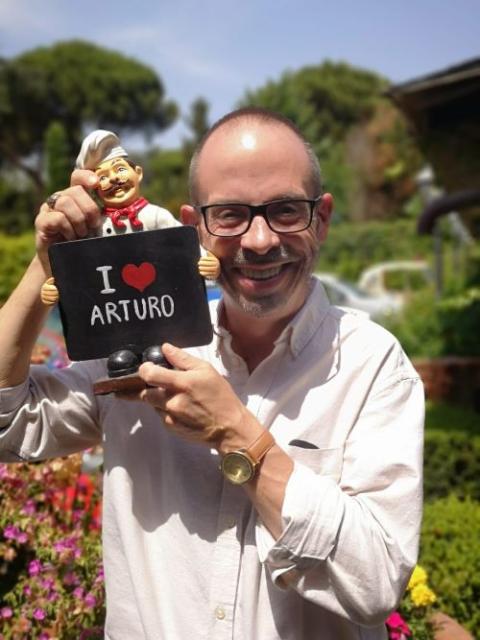
John L. Allen Jr. stands outside Ristorante Arturo in Rome in this undated photo. (Courtesy of Christopher White)
Located about 10 minutes from the Vatican by taxi, Arturo’s was one of John’s regular haunts. He often joked that he had put the children of the owner, Bernardo, through college thanks to the amount of money he’d spent there.
The plan was set: “Your flight from New York lands midmorning, so by the time you go through customs and get into a taxi, it will be lunchtime. Have the driver take you directly to Arturo’s, and we’ll all meet there for a team lunch.”
A few days before I was due to travel, John alerted me that there was a problem — but that he had fixed it. I was due to arrive on a Monday, the giorno di riposo for Arturo’s. Now, had John consulted with me I would have told him that I understood perfectly well that the restaurant and its workers needed their weekly day off. John opted for a different approach.
“I told Bernardo that this was your favorite restaurant and convinced him to open on Monday!” he informed me.
Sure enough, a few days later when I arrived in Rome, Bernardo was there to let us into the restaurant. Except once we were all inside, he locked the doors behind us. He wasn’t opening the restaurant for full service — he (and a cook) had come in on their day off for John.
Initially, John felt embarrassed by this. He told us to order plentifully so that we could at least make it worth their while. We stayed for hours, having multiple courses and sinking several bottles of fine wine. John had also prepared a 20-point agenda for our team meeting. Crux was small but thriving and with the energy of a startup, John was keen to capitalize on our time together.
When it came time for us to depart that afternoon, John went to pay the bill, instructing Bernardo that today he was not allowed to give him his standard sconto (discount). With a twinkle in his eye, Bernardo said that there would be no conto (bill) at all. It was his pleasure to take care of one of his most loyal customers and everything was on the house.
With John’s death after battling stomach cancer for several years, many will rightly mourn the loss of the man who became one of the most prolific English language interpreters of Vatican affairs. I also mourn the loss of a mentor, whose same brash and tenacious style that convinced a restaurant owner to open for his friends on his day off allowed John the ability to penetrate Vatican walls to provide greater clarity on an often opaque institution.
John arrived in Rome to serve as the National Catholic Reporter’s correspondent there in 2000, giving him a front-row seat to the waning years of Pope John Paul II’s pontificate and the election of Pope Benedict XVI. This was a critical time in the life of the Catholic Church. John repeatedly broke stories about the Vatican’s cover-up and reluctance to confront the serial abuser priest, Fr. Marcial Maciel, the tensions between the Holy See and the United States over the invasion of Iraq, and the complicated U.S.-Vatican relations following the fallout of the American clergy abuse scandals in the early 2000s. In my opinion, John’s NCR obituary of Pope John Paul II is a master class that perfectly captures the complexities of a captivating pontiff who for nearly three decades took the world by storm, while inadvertently allowing things to unravel inside his own house.
Veteran colleagues who recall John’s arrival in Rome often do so with a smile, recounting a somewhat sloppily put together Midwestern man who was uncomfortable wearing a formal suit, yet desperate to be taken seriously by an institution defined by its formalities. That drive fueled his near overnight success, eager to prove that he should be taken seriously. And he was — becoming a regular presence on CNN and often being the first phone call for mainstream news outlets when they needed someone to make plain what was often imperceptible. Throughout his career, John managed to make almost every analogy to baseball imaginable.
As a correspondent for the notoriously progressive NCR, John was determined not to be shut out during the papacies of John Paul II and Benedict XVI. He adopted a mindset that became fundamental to my own thinking on the job, which was that one had to be willing to talk to everyone. Yet that same zeal to be taken seriously by those on the inside would also lead to a criticism that John had become too enmeshed in the power structures of the Vatican, and the revolution brought about by the election of Francis in 2013 left him disoriented, and his insider access limited. Still, when I first began visiting Rome, it wasn’t just Catholic news junkies who would stop John on the streets or in Vatican trattorias. More than once, it was a curial cardinal or bishop that would come up and eagerly greet John before he had even spotted them. That’s a rarity in a town where discretion is often paramount.
Part of what made John a must-read during his early career was not just his clarity of style and the sense that he had his finger on the pulse of what was happening inside the Vatican, but that he also paid close attention to the often ignored aspects of Catholic life that would shape and reshape the institution in the decades to come. His 2012 book, The Future Church (one of 11 books he wrote on the Vatican and the Catholic Church), is a perfect testament to this and largely holds up today. When I filled in for John at a 2019 conference of African theologians and bishops in Nigeria, multiple prelates told me that John was the only American Vatican journalist that seemed interested — and agenda-free — in wanting to understand the dynamics of Catholic life on the continent.
After nearly 17 years with NCR, John left this paper, enticed by The Boston Globe’s plan to launch a vertical publication covering the Catholic Church . The Globe, citing financial reasons, pulled out after less than two years, declaring “we made the words work, but not the numbers.” After what John would often describe as “the most amicable corporate divorce in history,” he became the owner of the news site.
It was in this era that I really got to know John, as he took a chance on me as a freelancer and then eventually as a full-time staff member. The finances of Crux were precarious but the readership was strong, anchored by John’s reputation. John recruited a young team of talent (launching the careers of Ines San Martin, Claire Giangrave and his beloved wife, Elise Ann Allen) and he often remarked that he’d never had as much fun in his life.
There was a downside to that: John was a remarkable reporter who struggled with the transition to also playing the part of publisher. Business acumen was never his strong suit, leading to an often haphazard operating style, and I often warned John that Crux’s financial partnership with various Catholic dioceses, bishops and ministries would compromise his stated goals of independence.
When I left Crux in 2020 to join this paper as its national correspondent, John was his typically gracious self, writing that “if they take care of you half as well as they did for me over almost seventeen years, you’re in great hands.” A year later when I moved to Rome to serve as NCR’s Vatican correspondent, the same posting that had defined his own career, John hosted a dinner party for me on my first night in town. And, for good measure, knowing that I am a bit of a Luddite, he also preemptively set me up with a VPN and several digital streaming accounts so I could continue to watch American television.
John — who never had kids of his own — often said that the young journalists he’d recruited had become his own children, or at least a piece of his legacy. Given that John began his career teaching high school in Los Angeles and serving as the faculty adviser to the student paper, John was most fulfilled when he was teaching and training the next generation. And I’ll never forget sitting next to John at a screening of a documentary about Pope John Paul II at the Angelicum in Rome. John, who had been raised in Kansas by a single mother, recounted through tears his own first encounter with the Polish pope as a defining moment in his life.
I last saw John during a visit to Rome in October. He was back in the hospital, but remained keen to talk shop, so I asked him for his assessment of Pope Leo XIV’s early months on the job. John remarked that although he’d often been critical of Francis’ style, he’d been supportive of the substance and the general direction of his papacy. Leo, he said, was managing to get both right.
Many things contribute to the biases of both elements of that statement, among them the fact that many of John’s best sources were those viewed as the opposition to Francis and that Leo had given his first interview to Crux.
But after saying farewell to John that day, I couldn’t help but think of another, likely prevailing factor. John had spent his entire professional career helping American reporters and readers alike make sense of a strange place and finding his own place within it. And there was John, at the end of his life, witnessing the most unlikely and yet rewarding of circumstances: the fact that another American had made it in Rome.
**************************
CRUX: John L. Allen Jr, 1965-2026
By Crux Staff
Jan 22, 2026
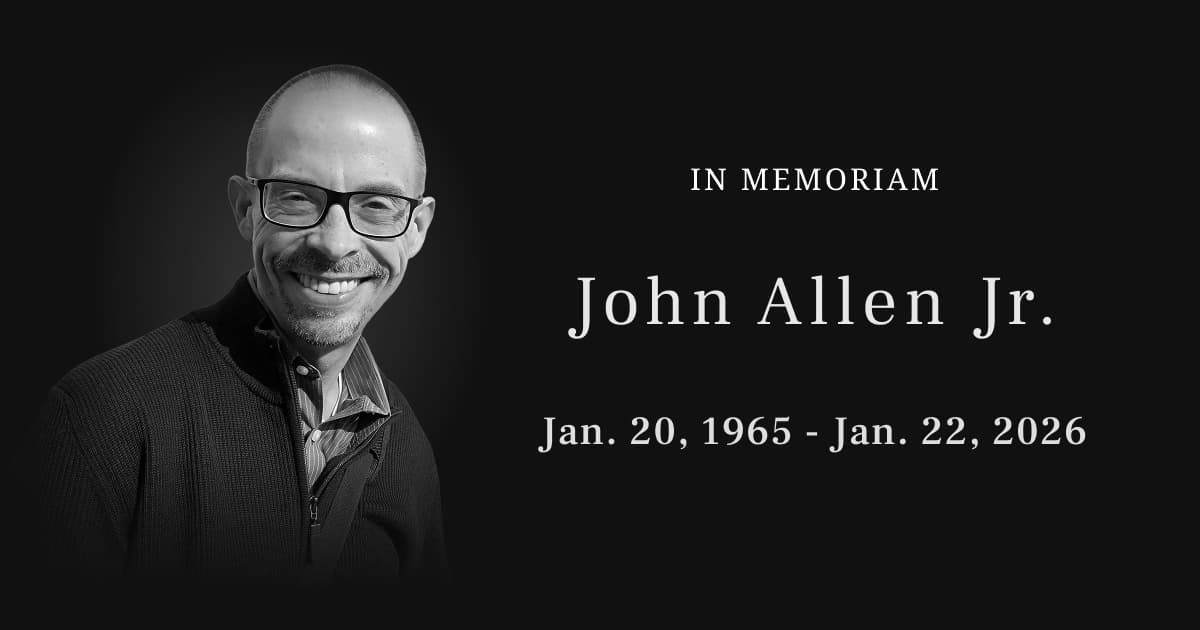
Link: https://cruxnow.com/church/2026/01/john-l-allen-jr-1965-2026
John L. Allen Jr. died on January 22, 2026, after a lengthy battle with cancer. The legendary Vatican beat reporter and Church affairs analyst was 61 years old. He is survived by his wife, Elise Ann Allen, who is Crux’s senior Rome correspondent.
Allen was a force of nature, certainly as a journalist who was not only our principal but also a model for us, whose counsel and whose company we already and forever shall sorely miss.
Allen was a patient mentor, a generous colleague, and the consummate newsman.
Keenly as we feel his absence in the newsroom, we also mourn the loss of a man who had been our dear friend for the better part of three decades.
We recall many convivial gatherings with Allen in restaurants and at his home in Rome, where he enjoyed exercising his formidable culinary prowess and was a prodigiously gracious host.
While we treasure the memories we made with Allen at table – some of them admittedly fuzzy – we clearly remember with powerful gratitude the countless kindnesses he visited on us in secret, through more than twenty years of friendship that began in the Eternal City and will, we fondly hope, continue in happy eternity.
Leading voices from across the spectrum of opinion in the Church praised Allen as “the journalist other reporters – and not a few cardinals – look to for the inside story on how all the pope’s men direct the world’s largest church,” to say it with Kenneth Woodward.
Allen spent seventeen years with the National Catholic Reporter, during which he became “the most authoritative writer on Vatican affairs in the English language,” according to The Tablet, and “the best Anglophone Vatican reporter ever,” according to conservative biographer of Pope St. John Paul II, George Weigel.
In 2014, Allen joined the Boston Globe’s Crux team, where he served for two years as associate editor before the Globe spun Crux off, leaving Allen to pilot the organization as CEO and editor-in-chief.
Under Allen’s editorial leadership, Crux has continued undaunted and undistracted in its mission of newsgathering and reporting, amid momentous changes in the Church and in global politics.
Through thick and thin, fat years and lean, Allen tenaciously preserved Crux’s editorial independence, always with both eyes firmly fixed on the work of getting the story, getting it right, and getting it out.
“Crux does the news,” Allen would say, and he led by example, relying on a core of dedicated and capable journalists and fostering an editorial culture infused with his newsman’s ethos.
Buttressed by new and dynamic business leadership in the creation of which Allen was instrumental, Crux is equipped to carry forward its mission: to provide – as Allen liked to say – the very best in smart, wired, and independent coverage of the Vatican and the Catholic Church around the world.
We ask your prayers for our friend, John L. Allen Jr., for his widow, Elise, for all who loved him, and for the work he advanced with whole-hearted and single-minded devotion, work we shall surely continue.
Charles Collins and Christopher R. Altieri
The Editors
I never met John personally, but I followed his articles from Rome for years. I did recognise his gradual drift to a more traditional line, and his disapproval of Francis, as Christopher mentions above.
I had one talk with him on the phone around the time the ACP were trying to see if we could do something to oppose the new translation of the missal. I got nowhere. He was very polite, but the substance of his message amounted to ‘this is it, lads; take it and get on with it’.
There’s a lovely tradition of speaking well of the dead in Ireland and it’s a shame to see Tony breaking with this tradition less than 24hrs after the man, a friend to many of us in Catholic journalism, died. Who of us is perfect? And John is not here to defend himself. For him and his memory I’ll paraphrase Shakespeare: Yes he was a man, take him for all in all, / I shall not look upon his like again.
That’s a very strange comment by Garry O’Sullivan reacting to Tony Flannery’s earlier comment on the late John L. Allen. Methinks there is something peculiar about it! After all, though Garry rather piously justifies his criticism of Tony on the basis that in Ireland we have a tradition of never speaking ill of the dead, it is a bit of a presumption to equate Tony’s comment with ‘speaking ill of John Allen’. It wasn’t and he didn’t.
John Allen, I suspect, would be less aggrieved by it than Garry was as is obvious from his peculiar rush to defend him as Tony was obviously not aggrieved by Allen’s legitimate riposte.
It does no service to John Allen to suggest that he would be unhappy about Tony’s comment. John Allen’s record as a journalist is more substantial than Garry’s inexplicably tedious reservation would give him credit for.