NCR Online: Soline Humbert felt called to ordination. This Irish priest paid a price for supporting her.
by Sarah Mac Donald, April 27, 2026
Link to article: https://www.ncronline.org/news/soline-humbert
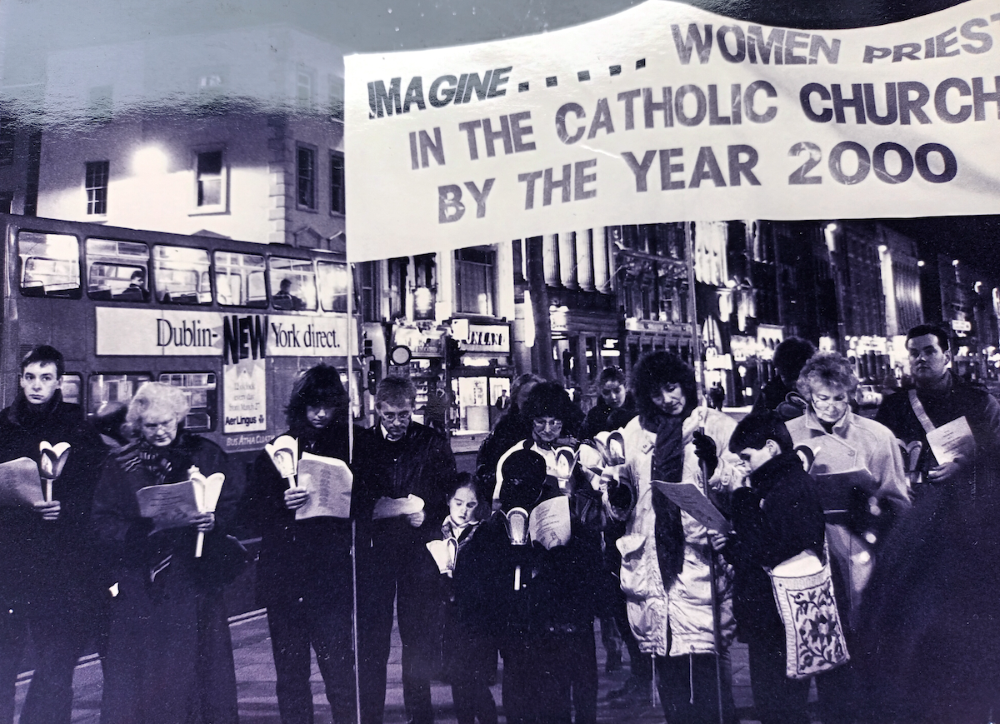
A banner reads “Imagine women priests in the Catholic Church by the year 2000” at the first World Day of Prayer for the Ordination of Women Priests, held March 25, 1994, in Dublin. (Courtesy of Soline Humbert)
At the first World Day of Prayer for the Ordination of Women Priests in 1994 in Dublin, Soline Humbert’s banner posed a challenge: “Imagine women priests in the Catholic Church by the year 2000.” Later that same year, the first 32 women were ordained priests by the Church of England. In contrast, the Catholic Church remains today a cold place for women who feel called to priesthood, such as Humbert herself, and for those who support them, like Fr. Eamonn McCarthy.
In her memoir, A Divine Calling: One Woman’s Life-Long Battle for Equality in the Catholic Church (Liffey Press, 2025) Humbert recounts her decades-long struggle to bring about an end to women’s exclusion from the priesthood. She grew up in France but moved to Ireland in 1973 to study at Trinity College Dublin. That is where she met McCarthy, who was a chaplain at the university from 1973-1983. In her book, she highlights the cost he has paid for supporting women’s ordination, including forfeiting his appointment as a parish priest and being out of a job for five years.
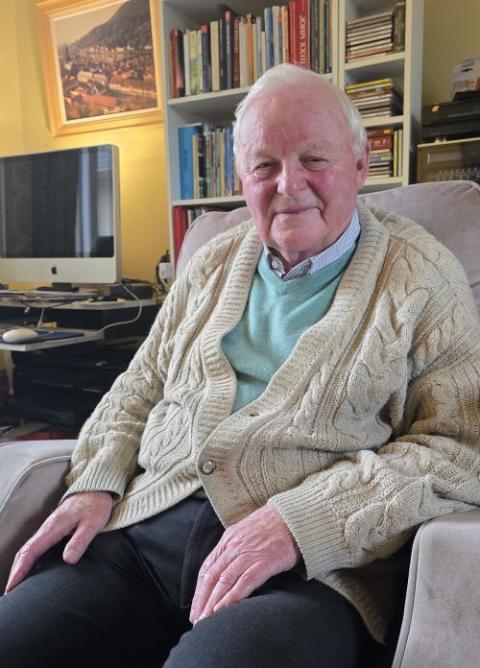
Fr. Eamonn McCarthy met Soline Humbert when he was chaplain at Trinity College Dublin and she was a student there. McCarthy is curate in the rural County Wicklow parishes of Holy Trinity, Donard and Our Lady of Dolours and St. Patrick in Davidstown. (Sarah Mac Donald)
“I was 32 when Soline spoke to me about her sense of vocation; it was during my time as chaplain in Trinity College. The church at the time was hard against the ordination of women,” McCarthy said in an interview with NCR.
In April 1976, the Pontifical Biblical Commission found that women could not be excluded from the priesthood on scriptural grounds. That report was never published. Instead, in October 1976, the Congregation for the Doctrine of the Faith declared that the church did not consider itself authorized to admit women to the priesthood.
McCarthy recalls Humbert as “an exceedingly bright young woman.” She was the youngest student and only woman enrolled in the MBA course at Trinity. “There were four prizes on offer at the end of the MBA year,” McCarthy said. “She won three of them outright and tied for the fourth.”
Humbert’s revelation about sense of vocation threw McCarthy off guard and he sought guidance in prayer.
“There’s an oratory in Trinity. I spent a lot of time in that oratory, giving out to the Lord at what he had landed me into,” he said. “One day I was there praying about it, and I noticed Scripture open on the seat next to me. I picked it up and read: ‘It is I, do not be afraid.’ It shook me. I said, ‘OK, if I’m picking it up, right — let’s go with it.’ ”
‘The institutional church has been very slow to recognize its spiritual abuse — it does violence to one’s spirit.’
—Soline Humbert
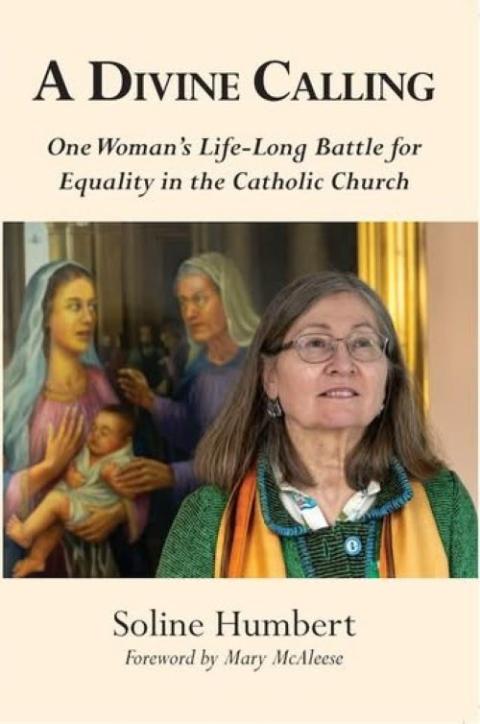
“A Divine Calling: One Woman’s Life-Long Battle for Equality in the Catholic Church” by Soline Humbert (Courtesy of Soline Humbert)
After 58 years of priesthood under institutional pressure and being sidelined, McCarthy remains committed to the belief that the time has come for the Catholic Church to admit women to the diaconate and priesthood. “Because if you look at the Acts of the Apostles, Chloe was a priest and the Eucharist was led by women as well,” he said.
McCarthy was ordained in 1967 by Archbishop John Charles McQuaid, renowned for running the Archdiocese of Dublin with an iron glove from 1940-1972. McQuaid famously asserted on his return to Dublin in 1965 from the Second Vatican Council that despite the talk of change in the church, “No change will worry the tranquility of your Christian lives.” In this traditional environment, McCarthy’s ordination class was the biggest that Clonliffe College, Dublin’s diocesan seminary, had ever seen.
Clonliffe closed in 2019 and the seminary has since been sold for property development. McCarthy feels no heartbreak at its passing.
“It’s no harm,” he said. “The institution is stuck in history. Christianity was doing superbly well until Constantine became involved.”
The 84-year-old priest’s outlook has been influenced by Swiss theologian Fr. Hans Kung‘s History of the Catholic Church, in which he blamed Constantine for corrupting Christianity into an empire-like structure.
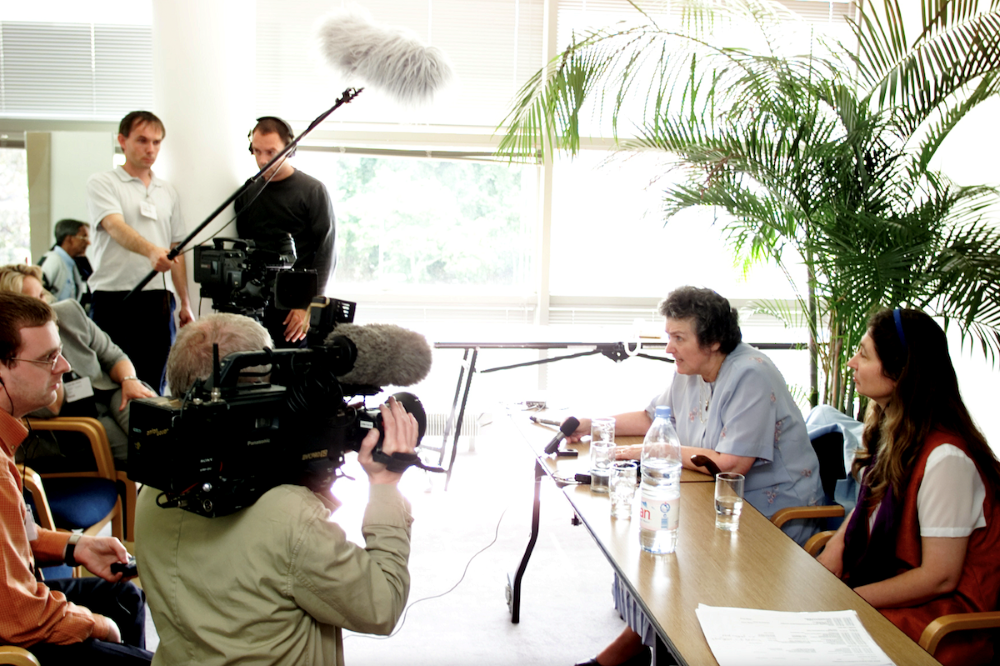
Soline Humbert, right, sits with Benedictine Sr. Joan Chittister at the Women’s Ordination Worldwide Dublin press conference in 2001. (Courtesy of Soline Humbert)
McCarthy serves today as a curate in the rural County Wicklow parishes of Holy Trinity, Donard and Our Lady of Dolours and St. Patrick in Davidstown. He fell afoul of the former archbishop of Dublin, Cardinal Desmond Connell, over women’s ordination, having been one of the speakers to address the first national conference on the ordination of women in 1995 in Dublin.
Shortly before the conference, McCarthy said Vatican sources let the organizers know that discussion of women’s ordination was not permitted.
“The venue had seating capacity for 300 people and, to our delight, all the seats were filled and there was up to 30 people standing at the back,” he said. “The opening address was given by Mary McAleese, who declared: ‘They say the issue may not be discussed. They had better turn up their hearing aids!’ With a degree of trepidation, I detailed something of the journey I had made in listening to a woman (Humbert) who had a sense of calling to ordination. Part of my trepidation was the possibility that the church might act against me.”
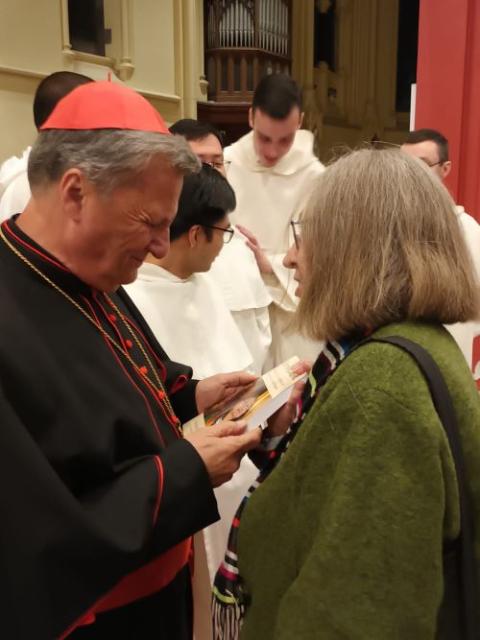
Soline Humbert presents a copy of her book “A Divine Calling: One Woman’s Life-Long Battle for Equality in the Catholic Church” to Cardinal Mario Grech of Malta. Grech is secretary-general of the Synod of Bishops. (Courtesy of Soline Humbert)
Later during a sabbatical in the west of Ireland, McCarthy began to think a lot about women’s ordination.
“I had been reflecting and praying, and what had come to me was that the legacy Jesus left us was threefold — essentially that as his followers, we would a) keep his memory alive; b) as he had loved us, we too, should love one another; and c) that he would send his spirit to journey with us through life,” he said. “In particular, it had come to me that, if the spirit of God is gifted to us as human beings — in baptism and confirmation — surely the obligation on church leadership is to seek to ascertain what it might be that the spirit of God is prompting in people’s lives. After all, that gift of the spirit of God breathes life into the day-to-day existence of Christians and becomes a distinguishing characteristic of Christianity.”
He penned a letter to the then-Dublin Archbishop Connell. “Within days, I got a letter from him asking if we could meet.” Over the course of two or three meetings, Connell tried to impress his viewpoint on McCarthy and “quoted the Vatican’s 1994 statement (Ordinatio Sacerdotalis) which declared that ordination is reserved to men alone.”
He told McCarthy he planned to install him as a parish priest in the Dublin area of Tallaght.
“But before he could do that, I would have to make a declaration that I would support the teaching of the church, which included the statement that ordination is reserved to men alone,” he said. “I told him that given the journey I had made through the previous years, that there was no way I could embrace such a declaration.”
Connell dispatched McCarthy instead to a very “difficult” parish as a curate. Despite his efforts to minister there, the challenges ultimately forced him to leave the position. “That Sunday I accepted a bed from Soline and her husband Colm at their home in Dublin,” McCarthy said. He stayed for a year and then moved to an apartment loaned to him by a friend.
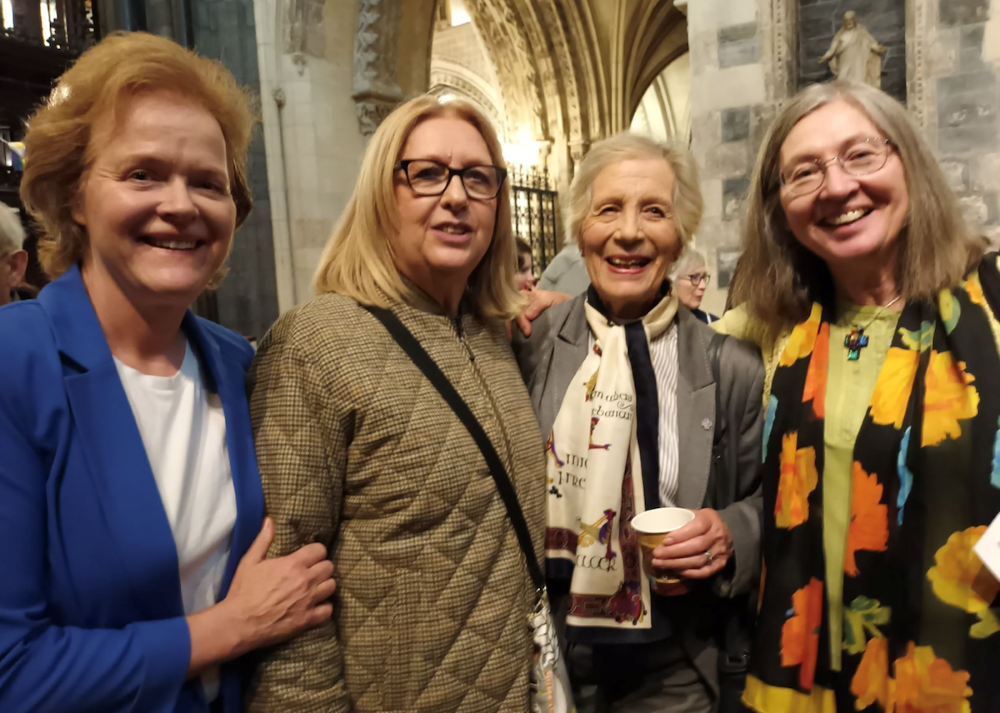
Ursula Halligan, Mary McAleese, the Rev. Ginnie Kennerley of the Church of Ireland and Soline Humbert pose in an undated photo in Christ Church Cathedral, Dublin. (Courtesy of Soline Humbert)
On April 26, 2004, Connell, who became a cardinal in 2001, retired as archbishop of Dublin and was succeeded by Archbishop Diarmuid Martin. The new archbishop asked McCarthy about his argument with Connell.
“I told him of my journey, after which he appointed me to my present position as curate in Dunlavin parish, with responsibility for the area of Donard-Davidstown,” McCarthy said. “That was at the end of September 2004 and nearly 22 years later, I am still, very happily, filling that post.”
For Humbert, it’s painful to know that her friend’s troubles began because of his support for her own quest for recognition.
“It is not a very nice institution,” she said. “The whole point of John Paul II’s declaration was to shut down the debate on women’s ordination. It was a very violent and forcible response. People were very fearful because there were a lot of denunciations and many decided they wouldn’t speak about it. Theologians, religious and priests were very vulnerable, even some lay people like teachers were affected. So, it worked to that extent. The institutional church has been very slow to recognize its spiritual abuse — it does violence to one’s spirit.”
Humbert co-founded BASIC (Brothers and Sisters in Christ) in 1993 to promote the ordination of women to priesthood. The nonprofit later became a part of We Are Church International.
“Girls could not officially serve at the altar and there were big controversies if they were allowed. It was a very cold, harsh climate,” she said. She notes the paradox that Bishop Donal Murray, auxiliary bishop in Dublin, told her during a meeting in 1993: “It is not God who calls one to the priesthood, it is the church who does. And the church is not calling women.” Yet he was reported for having girls as altar servers on one occasion.
“Of course we have moved since that,” Humbert said. “But today it is the diaconate — commission after commission, more studying — it’s still blocked. Women had been knocking at the door, and instead of opening it, we were told to stop knocking. The door is closed to us.”
Excellent article by Sarah MacDonald who interviewed Eamonn McCarthy, who was left with no appointment for 5 years because he supported the ordination of women.
I hope your article might encourage our bishops to voice their opinions about the ordination of women? As we are all encouraged to share with Pope Francis’ and Leo’s Synodality? There being no theological argument to exclude women, only cultural baggage? Or will they duck and say “That’s for Rome to decide?”
“In April 1976, the Pontifical Biblical Commission found that women could not be excluded from the priesthood on scriptural grounds. That report was never published. Instead, in October 1976, the Congregation for the Doctrine of the Faith declared that the church did not consider itself authorized to admit women to the priesthood.”
I’m reading a stupendous 1000-page book by Sylvio Hermann de Franceschi, La crise théologico-politique du premier âge baroque (Ecole française de Rome, 2009). It begins by telling how the Council of Trent in its last days surrendered supreme teaching authority to the Pope and how relentlessly pope and curia implemented this Roman centralization, using theology (with star theologian Robert Bellarmine, SJ), history (star figure Cesare Baronius), canon law, art, and piety for this purpose. While no one dared to add “Roman” to the four notes of the church named by the Creed of Constantinople (one, holy, catholic, apostolic), in practice “the church was henceforth catholic because Roman”. The papacy persecuted those who did not recognize the direct authority of the Pope in secular matters, a position that today would be absurd. Eight very active new congregations (dicasteries) were set up to implement Trent in the key of Roman centralization (the discussions of the Council were under embargo, seeing the light only in the 20th century). In 1588 a papal bull affirmed the primary place in the curia of the Holy Roman and Universal Inquisition (the Holy Office, later CDF, recently renamed again), which had been set up in 1542, The book covers the period 1607-1627 and French resistance to this development. At that time the powerful presence of Paul V and his Cardinal Nephew Scipione Borghese weighed heavily. Not for nothing is Paul V’s name emblazoned on the facade of St Peter’s. Today the church has greatly changed its theology and John Paul II issued more than ninety apologies for past mistakes. But the centralization implemented in that key period has not been corrected.
Just as the Biblical Commission’s report could be suppressed by the CDF, so could an author of the enlightened document, Dialogue and Proclamation, Jacques Dupuis, SJ, be hounded and harried by the CDF to give teeth to its not so enlightened Dominus Iesus. The CDF has a stranglehold on doctrinal development which equals that of Iran on the Strait of Hormuz. If it remains true to form, I imagine that the CDF must be keeping its eye on synodality, seeing it as an avatar of the dreaded, imperfectly exorcized Conciliarism of the 15th century. Von Balthasar chided theologians for their “anti-Roman affect” but if such a book as de Franceschi’s can be published in Rome, albeit under French auspices, perhaps that is a promise that the spirit of Gallican resistance was more than an impotent affect and can inspire creative renewal today.
‘“It is not a very nice institution,” she said. Reflecting on what Gabriel Daly, OSA, called Vatican “skullduggery” as manifested in the way Werner Jeanrond was treated, recalling the still unappeased spirit of the late Sean Fagan, thinking of how shabbily Tony Flannery, and Eamonn McCarthy are “handled”‘ by unthinking prelates armed with rulebooks, and noticing also the insulting treatment of Soline Humbert and Mary McAleese, I have the feeling that the Vatican indulges in archaic medieval attitudes where Ireland is concerned, and I wonder what long traditions of cowardice, conformism, silence, and hypocrisy on our part have made Rome feel empowered to abuse us in this way? Or is it the same everywhere?
Joe describes the Vatican attitude to those perceived as Liberal.
And yet, Cardinal Fernandez and his head of discipline Archbishop John Kennedy (formerly a priest of the Dublin Archdiocese), have prepared the Documents for excommunicating The SSPX on July 1st. This time, excommunications will apparently not be limited to Bishops.
Fr. James Martin has Vatican celebrity status.
The Vatican is condemning both Trads and Progressives.
Dermot, the SSPX have been in an irregular canonical position for a long time, but the idea that the Vatican intends to excommunicate the entire group lock, stock, and barrel seems unlikely to me. The sources you give are all trads, such as Rorate Caeli (who is a single individual I knew as Chris on a rather malignant website before he left to form his own website), or bishops Fellay and Schneider. As their brouhaha about Pope Francis’s alleged persecution of TLM worshippers shows, they love to create this kind of furore.
Fr Martin counts as a progressive, but he is also a holding operation for the Vatican, excusing them from any “purification of memory” for a terrible past or any consideration of development for a better future. John Paul II made something like 93 apologies for church errors, some expressed in so minimizing a manner as to come across as ridiculous – e.g. belated admissions that Copernicus was right and the earth goes round the sun, or sadness that in their “zeal for truth” “some Christians” went too far — but among these apologies, where is that to lgbt folk?