
The Witness of Our Words: John Allen, Taylor Marshall, and the Catholic Culture of Contempt
May 29, 2026
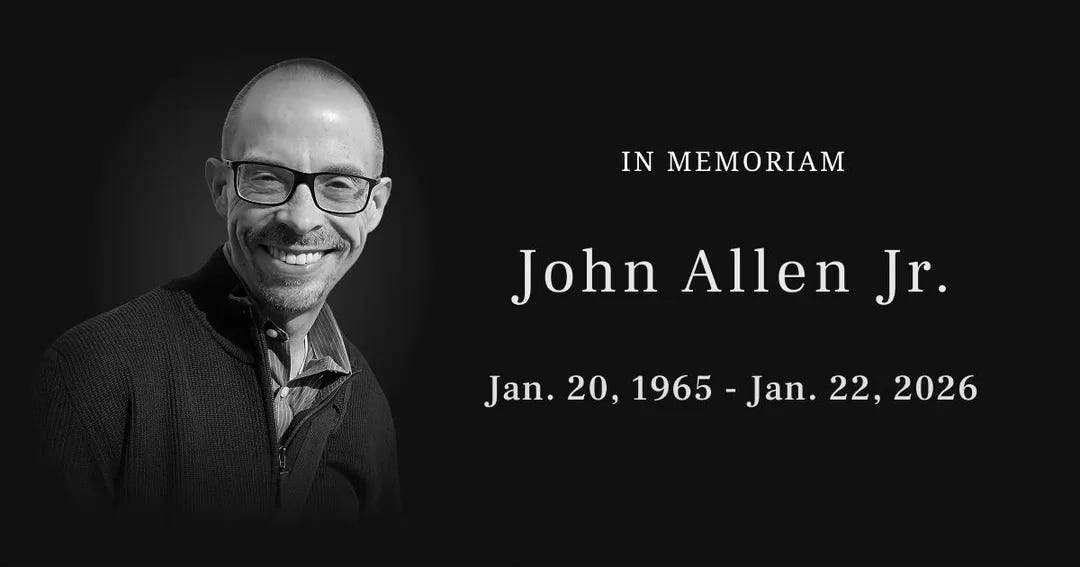
John L. Allen Jr. died on January 22, 2026, two days after his sixty-first birthday, in Rome — the city he had made his professional home and the beat he had covered with unmatched distinction for nearly three decades. The London Tablet once called him “the most authoritative writer on Vatican affairs in the English language,” and in my experience of reading him across those decades, that was not flattery. It was accurate description.
His final book, Catholics and Contempt: How Catholic Media Fuel Today’s Fights and What to Do About It (Word on Fire, 2023), is now, in the fullest and most poignant sense, his last testament to the Church he loved and served. I have been reading it with both admiration and grief — admiration for its clarity and honesty, grief because the Church he diagnoses with such precision continues, even now, to exhibit the pathology he named.
I want to reflect on that diagnosis. And I want to name one of its most prominent practitioners.
The Diagnosis
Allen’s central argument is deceptively simple: the Catholic Church, which understands itself as the evangelizer of culture, has instead been evangelized by the culture of contempt. The 24/7 outrage cycle, the rise of what he calls “cheap speech,” the discovery that audiences are more reliably monetized through rage than through reason — these forces, Allen argued, did not stay outside the Church’s doors. They walked right in, found a congregation eager for ideological combat, and set up shop.
The culture of contempt, Allen wrote, is defined by its core impulse: a lust to wound perceived opponents who are seen not merely as wrong, but as evil. It does not merely disagree. It dehumanizes. And in dehumanizing, it commits a particular offense against the Catholic tradition, because the dignity of the human person — every human person, including the one whose position you find repugnant — is not a liberal talking point. It is a dogmatic datum of Catholic Social Teaching.
What gives Allen’s analysis a genealogical depth that I find particularly important is his tracing of the phrase “culture of contempt” to the twentieth-century Jewish historian Jules Isaac, who used it to name what he called the Church’s historic “teaching of contempt” toward Judaism — a teaching that prepared the soil in which the Holocaust could grow. Isaac’s work, as Allen noted, was directly influential on the drafting of Nostra Aetate. The phrase is not accidental. It carries the weight of history’s worst verdict on what happens when contempt is institutionalized and sacralized.
Allen was also honest enough to begin with himself. He opens the book by recounting how, when his first wife sought a divorce, he became the target of a vicious hit piece by Michael Voris and Church Militant, which portrayed him as living in an adulterous relationship — a characterization that was not only unkind but false. Allen had received a declaration of nullity for his first marriage, which had never been celebrated in a Catholic ceremony. He remarried Elise Ann Allen, his colleague and companion, in full standing. None of that mattered to the attack machine. He had become a target — not because of what he had actually done, but because he was insufficiently hostile to Pope Francis, and contempt requires enemies, not nuance.
I witnessed those attacks. I found them contemptible then, and they are no less contemptible in retrospect. John Allen was a man of integrity, of measured judgment, of genuine faith. He deserved better from the Church he served. That he chose to begin his final book with that experience — not in bitterness, but as a sober example of the pathology he was naming — says everything about the kind of Catholic he was.
The Practitioner
If John Allen is the diagnostician, Taylor Marshall is the case study.
Marshall is a former Episcopal priest who converted to Catholicism in 2006 and subsequently built one of the largest traditionalist media platforms in American Catholic life. He holds a Ph.D. in philosophy from the University of Dallas. He runs an online theology institute, a Catholic scouting organization, and a self-publishing imprint. He produces a YouTube channel and podcast that his followers number in the hundreds of thousands. By any metric of Catholic media reach, he is a significant figure.
And he is a nearly perfect embodiment of everything Allen warned against.
His 2019 book, Infiltration, accused Pope Francis of being — and I will quote this directly, because the words must be confronted, not softened — “a Pope for Satan on the Roman Seat of Saint Peter,” the product of what Marshall called a “slow, patient plan to establish a Satanic revolution with the pope as puppet.” This is not theological dissent. It is not legitimate criticism of a papal document. It is not even the kind of principled canonical argument that a serious scholar might advance and defend. It is dehumanization in religious dress — precisely the pathology Allen identified as the terminal expression of contempt.
Marshall twice publicly declared Pope Francis a heretic. The charge was, by canonical standards, specious: formal heresy requires not merely doctrinal error but obstinate persistence in that error after rebuke by Church authority — a threshold Marshall made no serious effort to meet. He also personally funded a theatrical act of vandalism at the 2019 Amazon Synod, bankrolling the theft and disposal of indigenous statues from a Roman church — and then uploaded the video for his audience’s enjoyment.
There is not a scintilla of the magisterial tradition of legitimate dissent in any of this. What there is, in abundance, is the lust to wound.
What happened when Cardinal Prevost was elected Pope Leo XIV? Marshall, who had publicly identified Prevost just days before the conclave as the worst possible pick for pope among credible candidates, broadcast his shock live. He then posted formal submission — “I submit to Pope Leo XIV” — before resuming, within weeks, the familiar catalog of grievances: Leo was ignoring Latin Mass momentum; Leo was promoting “pro-LGBT, anti-Latin Mass” bishops; Leo was failing to reverse his predecessor’s restrictions; and most recently, when the Vatican issued its formal warning to the SSPX, Marshall framed it with a characteristic episodic title — “Vatican in Conflict? SSPX Bad? Same-Sex Good?” — collapsing a grave canonical matter into the vocabulary of YouTube provocateurs.
This is what Allen meant by the culture of contempt having evangelized the Church. Marshall did not receive the Church. He auditioned it. He found it wanting when it failed to conform to his curated vision, declared the institution corrupt, and then built a media empire on that declaration — complete with monetized theology courses, a self-published backlist, and a Patreon audience sustained by perpetual outrage. The theology follows the business model.
The Witness We Are Called to Give
I have spent over fifty years as a Catholic priest, and I have engaged in my share of genuine theological disagreements — with colleagues, with episcopal authorities, with the direction of particular documents. Disagreement within the Church is not only legitimate; it is often necessary. The tradition has always had its internal tensions, its vigorous debates, its moments of real conflict between serious people of good faith. That is not what the culture of contempt is.
The culture of contempt is something else entirely. It is the conversion of a theological difference into a declaration of enmity. It is the refusal to grant your opponent even the dignity of honest error. It is the slide — which in the Catholic media ecosystem has become almost automatic — from “I disagree with this” to “this person is evil” to “this person is an agent of Satan.” It is what happens when the grammar of faith is colonized by the grammar of warfare.
John Allen named this with the precision and courage it required. And he named it, characteristically, with humility — offering himself as the first example, the journalist who had once coined the phrase “Catholic Taliban” and lived to regret it, who had been the target of the very machine he was describing, and who chose to respond not with counter-contempt but with clarity.
That clarity is itself a form of witness. Allen understood what the tradition calls the lex vivendi — the law of living, the recognition that how we act enacts what we believe. Our speech is not merely instrumental. It is liturgical. It either conforms our lives to the truth we profess, or it contradicts it.
Taylor Marshall calls himself a defender of tradition. But tradition, in its fullest Catholic sense, is not a posture of combat. It is a transmission — a living, loving, costly handing-on of what we have received. What Marshall transmits, through every episode and every broadside, is contempt dressed in a cassock.
John Allen’s last book deserves to be read widely, and not only as a media critique. It is a work of ecclesiology. It asks the Church to examine what kind of community it actually is — not what it professes on Sunday, but what it practices on Monday, in the comment boxes and the podcast studios and the Substack posts.
Including this one.
I try to hold myself to that standard. I do not always succeed. But I know that the witness of our words is not separable from the witness of our lives, and that the Church’s credibility in a contemptuous age depends, in no small part, on whether those of us who speak in her name have learned, from people like John Allen, the difficult discipline of speaking the truth in love.
Requiescat in pace, John. The Church needed you. She still does.
Monsignor Arthur Holquin, S.T.L., is a retired Catholic priest of the Diocese of Orange, California, and retired rector of Mission Basilica San Juan Capistrano. He publishes Liturgy and Truth on Substack.