Irish Catholic: People Need Priests More Than Ever Before
A member recommended this article from the Irish Catholic series Relentless Ministry, first published 27 Feb 2025.

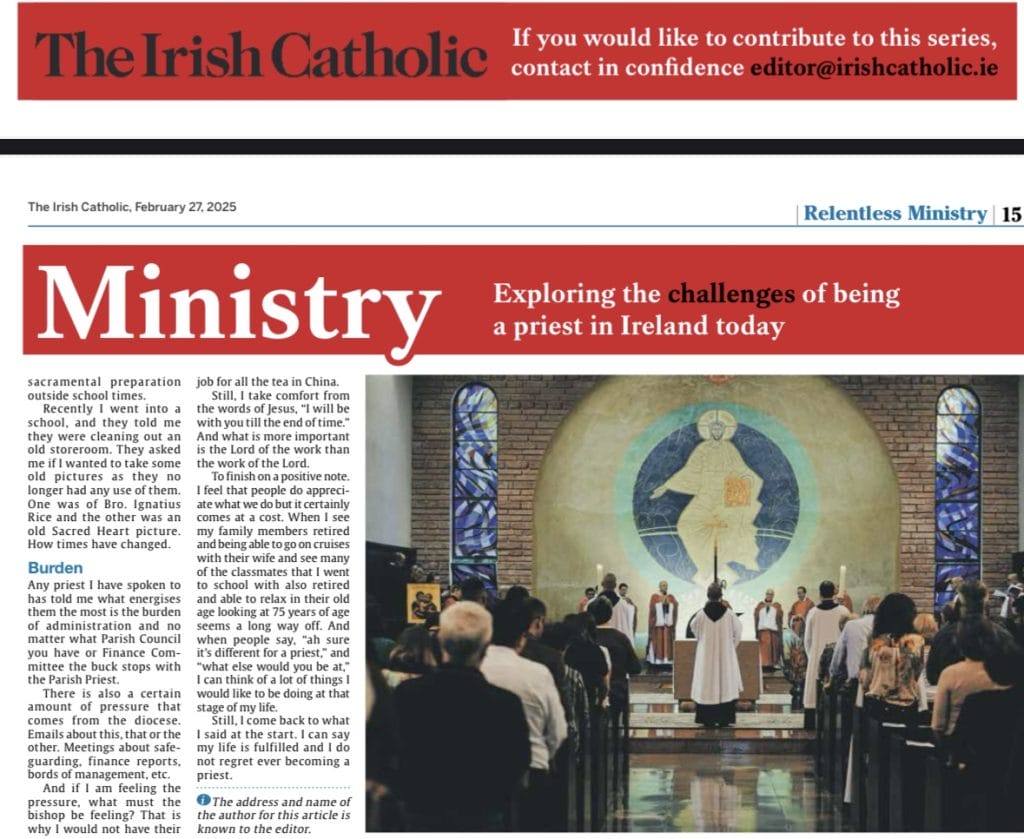
A member recommended this article from the Irish Catholic series Relentless Ministry, first published 27 Feb 2025.
Rhododendrons, Bluebells and Dandelions A carpet of bluebells: A text came from M. She announced that her bluebells had appeared. I was nostalgic. My past loomed large. The carpet of…
Request for assistance… I am searching for an account in fiction of the now almost gone country station. Could any of your members enlighten me? I am thinking of Canon…
Wood You Believe The Journey of Enlightenment A Pathway of Transformation Retreat Facilitated by Fr. Jim Cogley and Luba Rodzhuk This retreat will offer a unique opportunity for those seeking…
Note: The seminar on Healing the Family Tree scheduled for Friday May 17th in Lady’s Island is fully booked. Another is planned for Saturday June 15th and is filling fast….
INTERNATIONAL WOMEN’S DAY Register for 8th March 8pm Why DIY? We believe that our Church is capable of change, to become safe, just and wholly inclusive. But whilst we thousands…
I feel many priests are in effect bearing a cross in their lives and they know more about the teaching on such crosses than I do so I won’t comment further. Mention was made in the article of Irish priests in Africa in times past. Priests and bishops today can learn a lot from knowledge of that situation. I observed it myself in the 1970’s. Briefly, I saw how individual priests in parishes the size of Co Limerick, divided them into nine or ten stations, each of which the priest visited maybe once every three weeks in the dry season and less so in the wet season. There had to be a voluntary involvement of service on the part of the laity, or to be precise of a small number of the laity. Native born priests were almost non-existent and it was often opined that the matriarchal nature of the culture would militate against a native cohort of priests emerging. Now I hear of priests from that country working in South Africa and I have watched a video on the internet depicting many native priests at a celebration in a church in the capital city and not a white face in sight.
One lesson is that there are no quick fixes.
Thanks to the generosity of so many priests in Ireland there is as yet no shortage of priests in Ireland, relative to the situation in Africa as it was in the 1970’s there. The Irish priests there then settled for what they were able to do with varying degrees of self-sacrifice. They first decided on what was possible in terms of the needs of the people and then built organisation around that. Necessary, feasible service first, then organisation second. Not the other way around. The people found ways to make do on what the priests were able to manage. But it was not without its difficulties.
In Ireland currently, there is much too much emphasis in some influential circles on giving more authority to us laity. There needs to be far more emphasis on our responsibilities as Catholics. Practice of the faith in Ireland did not dwindle due to a shortage of priests. The reason for the dwindle is represented figuratively in the description of the dispensed holy pictures in the school rubbish room. Starting in the 1960s the people have made their choices regarding reception of the Catholic faith and things are as they are today.
The reign of the sacred cows of obsessive parish and diocesan loyalties is over. In terms of infrastructure we are in a far better situation that that which obtained in Africa in the !970s. The principle function of parish councils should be enabling people to travel outside their parishes to Mass on Sundays. This is far more important that gaining control of the microphone or of the cheque book at local parish events. Religious parish participation demands personal sacrifice, not the joys of power.
The priest has to be available but within reason. He must have time to concentrate on his prayer during the day. This is his best service to the people. Laity should affirm him in his sacramental ministry, and show they value it.
It’s a bit sad to have a priest talk about sermons of non-Irish priests being too long especially in the Irish context of catechetical ignorance. It is highly likely that the foreign priests were not raised on a religious diet of four minute sermons, which are probably an Irish institution.
The future is in God’s hands and in human terms it’s in the hands of young families. Priests, as a group, should try to see how they can help young parents in their ministry to their children. There is plenty of evidence overseas that shows how productive service to young parents can be.
And why do we not see greater promotion and indeed use of the services of those pockets of renewal populated by twenty somethings?
The shortage is not one of priests but of imagination.