
Jim Cogley’s Reflections – Tues 12 May – Mon 18 May 2026
Coming Events: A seminar entitled Healing the Wounds of our Broken Humanity -Growing Strong at Broken Places, with Jim Cogley and Luba Rodzhuk will be held in the Community Centre, Lady’s Island on Sat 16th May from 10am – 4pm. Bookings to 0877640407. There are a few spaces still available for this day in this beautiful setting.
Advance notice for those wishing to do a Summer Retreat: A 5-day residential retreat will be given by Jim Cogley and Luba Rodzhuk in the Spiritan Retreat Centre in Navan June 22nd to 26th. This will be entitled Coming Home to Ourselves –The Healing Journey. As these events tend to fill up quickly early booking is advised on 046-9078973
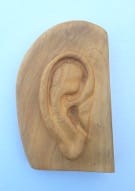
Tues 12th May – Give me your Ear
Babbling Prayer
It’s difficult not to come to the conclusion that if God gave us two ears and one mouth that He was placing double the importance on listening as speaking. This applies both to our prayer life and our everyday interactions with others. At the religious level there seems to be a huge emphasis on the multiplication of words in prayers as if God was going to answer if we said all the more and kept on kept on saying it. This stands in complete contradiction to the teaching of Christ that ‘when you pray, not to babble like the pagans who think that by multiplying words they will increase their chances of being heard’. In our Catholic tradition, for far too long, the advice to the young prophet Samuel that if he thought God was speaking his response was to be, ‘Speak Lord your servant is listening’ was replaced with ‘Listen Lord your servant is speaking.’ All of this begs the question of who has to say what is more important?
Wed 13th May – Silence – The Language of God
A beautiful line from the Second Book of Samuel says of him that ‘he let no word of God fall to the ground’. In other words, he learned the importance of having a listening ear. We live in a time much like the ancient prophet when visions and revelations were scarce and it was deemed unusual for the Lord to speak. It was a time of spiritual atrophy where cultural practices had become the norm but with no vibrancy of expectant faith. In our time we live in a culture of noise where it becomes increasingly difficult to find space for the language of God which is silence. To increase the speed rather than practice inner stillness is the desire of so many and while life becomes ever fuller the level of fulfilment gets less and less. Similarly, the more we increase the circumference of the circle as in our acquisitions and external accomplishments the farther removed we become from our centre which is the real source of life.
Thurs 14th May – The Silent Component
People who are really good listeners are truly rare, even though most of us might disagree and think we don’t do too bad! The word SILENT and the word LISTEN contain the same letters and if silence is not the essential component of our listening, we really have not got beyond needing to hear the sound of our own voice. Most of our listening is not with the intention of hearing but the intention of speaking. So, we find ourselves listening with the answer running and waiting for our opportunity to introject. Whatever our answer might be, and no matter how much good advice it contains, it amounts to bad news for the person who simply needs to be heard. The art of true listening is to be able to allow sufficient silent space for the person speaking to hear themselves and to make sense of whatever is going on in his or her own head. Helping someone to come to their own solutions from within is always preferrable to offering answers from without.
Fri 15th May – Being worthy of Trust
We all feel that we have a right to be listened to. This might be the telling of something that is important to us, events of the day, some item or incident of interest, something deeply personal or just something that is annoying us that we need to get off our chest. In terms of something that is personal or shameful it can take a lot of courage, and it needs the safety net of trustworthiness. Many resent not being told things by their partner but fail to see how they have a tendency to use such sensitive material as ammunition in a time of conflict. To be the custodian of another’s deepest self is a privilege that carries great responsibilities. We are only trustworthy to the extent that we hold what is shared in trust and never use sensitive information to belittle the other, even if the relationship is in difficulty or does not work out.
Sat 16th May – The Right Time
The quality of how we hold sensitive information allows the other to take ownership of it for themselves. It allows them to see it in a broader context, to be part of a bigger story and eventually to share it elsewhere or with a wider audience. When we want someone to listen, we may need to consciously request a listening ear and to be sensitive as to when that other is most free to give that ear. One lady says to her husband, ‘Joe I need your listener this evening’. Our emotional pressure to get something off our chest may be huge but an appropriate time needs to be found. When the other is busy going somewhere, doing something or is self-preoccupied is definitely not the time. For a wife to say, ‘Darling we need to talk’ when an important match is about to begin means she is definitely going to be the loser. Similarly, if there is something to be said that is difficult to hear, choosing an appropriate time when there will be no interruptions is important and certainly when no one else is present.
Sun 17th May – Ascension 26
Recently I came across a few original teachings of St Francis of Assisi where he refers to Ascension not just in relation to Christ and his ascension to heaven but more in terms of the challenge of Ascension in our own lives. In other words what are the big issues of life that we need to rise above. Two of them in particular he mentions that pose a challenge and yet offer a different way of looking at things.
First, he said that we need to become comfortable with imperfection in ourselves and so rise above whatever need we have to be good. In spite of our very best efforts, we will still be living imperfect lives and whether we like it or not we will die imperfect deaths. It is in the nature of being human to have a dark or shadow side that is always with us and from time to time will trip us up in order to keep us humble and to remind us of what we are made of. Wheat and weeds exist in every human being and instead of being dismayed at the weeds and think we have to keep up a running battle to keep eradicating them he surprisingly said ‘Learn to be comfortable with your imperfections’ and know that God doesn’t love you any the less because of them. You don’t have to be good, you just have to be yourself.
The second statement was also quite challenging. He said, ‘You must also learn to be comfortable with not being seen to be good.’ There are centuries of religious practice that comes under the hammer here where respectability was seen to be all important. ‘What will the neighbours think, keep up the family name, always be seen to do the right thing.’ Our religion was largely about external observances, and it was not uncommon for families to be forced out to go to Mass in their Sunday best and then to come home and be beaten black and blue. Nor was it unusual for families to come to the same altar rails to receive Holy Communion and to come out without a good word to say to each other and be bitter and at loggerheads for the rest of the week. What you did in church on Sunday was one thing, where you were seen to be doing the right thing, and what went on for the rest of the week was quite another.
I think St Francis would have agreed with the saying that ‘There is nothing that deserves less respect than respectability’. It was so strong in families in the past that parents were prepared to sacrifice their own daughters to Mother and Baby Homes and to a lifetime of forced labour. At the same time to sacrifice their own grandchildren for adoption, their own flesh and blood, on the altar of respectability. Countless young women were rejected and disowned by their parents because of bringing an unplanned child into the world they were deemed as having brought shame on their families. It’s nothing short of frightening to consider how far removed from the Gospel that our society and our church had become.
While St Francis doesn’t mention this, it would seem that another area we badly need to rise above, to ascend if you like, is our innate tendency to make judgements based purely on behaviour while making no attempt to look for the underlying reasons that gave rise to it in the first place. All behaviour is a form of communication. Should a child be behaving badly it is usually because he or she, for whatever reason, doesn’t feel loved and so they settle for attention. Donald Trump is a prime example of this. If someone is heavy on drink or drugs it is basically because they are trying to block out emotional pain. The substance itself may appear to be the problem but something else is the cause. It’s our judgements that always get us into trouble and come back to bite us in the you know where. That’s because the fault we see so clearly in someone else is really in ourselves.
A story you may have heard of was of a well-to-do lady who lived on the outskirts of a town and one day decided to walk in to do some shopping. Along the way she felt the place wasn’t as clean as it used to be and had become quite smelly. She walked into her bank and was appalled at the pong in the place and left a complaint. Later while waiting at a meat counter, she became aware of a rotten smell. Two or three other places along her route the same thing happened, and she said to someone she met that ‘This place has gone to the dogs, it’s become filthy and smelly, not at all like it used to be’. A few hours later she returned home and was glad to take off her shoes only to discover a large pad of dog poo that she had stepped on and carried with her for the entire day.
That’s the problem with being too judgemental. The stink may be real but it’s really ours to clean up first before we start pointing fingers.
Mon 18th May – Organs of Listening
The main organ of listening we presume to be the ear but for deeper listening it has to be the heart and the eye. We quickly sense that the other is no longer listening when they lose eye contact, the connection is broken and it’s obvious that they have gone elsewhere. This may not be entirely their fault because our delivery may be such as to bore the pants off someone or we are repeating the same old story. Similarly, when something of an emotional nature is being shared the heart connection with that significant other is of paramount importance. Usually, we find that in an instinctive way we never go beyond where that person has journeyed themselves and if we do stray into unchartered waters the other will become uneasy, judgemental and at that stage we have definitely lost that all important connection of the heart.