Jim Cogley’s Reflections – Tues 10 Nov – Mon 16 Nov 2026
Coming Seminars:
Wood You Believe
Tara Centre, Omagh
Fri 13th&-9.30pm Loss & Recovery
Sat 14th 10–4pm Discovering your Higher Purpose
with Jim Cogley and Luba Rodzhuk
Enquiries to Tara Centre 00 44 28 82250024
Tues 10th Nov – An Invitation to Wholeness
It is difficult when experiencing the excruciating pain of loss to see it as an invitation to wholeness. This happens at several levels. First, from an early age a couple may have been very co-dependent and lived life through each other to the point that the identity of each was in the other. When one is taken, for the other it is like Siamese twins being separated without anesthetic and can be quite life threatening. However, for the ones who do, they begin to live their own life for the first time and even begin to enjoy being their own person; the one they never allowed themselves to be before. Secondly, a significant loss will never happen in isolation to earlier losses and any of these that lay dormant but never integrated will inevitably rise into sharper consciousness. As part of the grief journey these unresolved losses will seek resolution. Lastly some of these losses may not be in relation to death but to unmet needs from childhood and during grief these too may scream for attention.
Wed 11th Nov – Letting Go
Thurs 12th Nov – Freedom
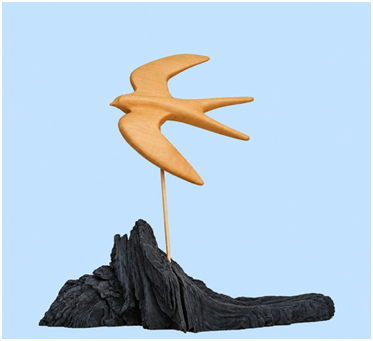
Letting go is a term that is often used in relation to grief work. However, it is unfortunate that the term carries connotations of farewells and goodbyes when this is not truly the case. We never say goodbye to anyone, but we do need to let go of how we once knew them, in order to get used to knowing them in a different way. Two birds will fly together, and weave in and out in perfect harmony, only because they are free of each other. However, tie them together and while they have four wings they will not be able to fly. This is a basic truth that is fundamental to resolving grief. Unless we release, we cannot have and in not doing so we condemn ourselves to a life of loneliness and emptiness. To love something is to set them free and if they come back to us in a new way only then are they ours forever. Letting go is essential to resolving grief. While it is a farewell to what was, it is an opening of the heart to what is.
Fri 13th Nov – Letting Go (2)
If we hold on to someone too tightly in life we call it control, and it has the effect of pushing them away from us. Jealousy is an expression of this, and it has been described as a monster that devours the object of its desire under the pretext of keeping it alive. For some reason when someone close to us dies we fail to see that our holding on, beyond an appropriate mourning period, is also a form of control. One man was shocked to realize that the holding on he thought was an expression of love for his wife was inadvertently a form of control. What holding on does to us is that it keeps us locked in the past. It makes our lives a misery in the present and it robs us of hope for the future. The greatest expression of our love for a loved one who has died is not by holding on out of morbid grief, but by releasing and letting them go. From the accounts of those who have experienced clinical death it would appear that morbid grief and holding on to loved ones can impede their progress on the other side. It certainly prevents us from moving forward.
Sat 14th November – Death of a Child
When a person dies old and full of years, we mourn the life that was and have gratitude in our hearts for that life that was fully lived. However, with the death of a child, it’s so much different. Here we have to mourn the life that never can be. The death of a child runs contrary to nature because every parent expects to die before their offspring. Only couples that have experienced such a tragedy know the strain that such a loss can place on their relationship. A couple are likely to grieve in such different ways that it drives a wedge between them. As a consequence, a large percentage go their separate ways. One example was where after the death of their child the mother went overboard on religion, but not in a healthy way. Meanwhile her partner turned to alcohol. Both were trying to numb their pain but through different types of addictive behaviours. Each was desperately searching for a connection in spirit with their child but was looking in the wrong place.
Sun 15th November – Talents
Reflecting on the message in that parable of the Talents today I think that it is really about being prepared to take risks with the game of life and accepting that we are going to make mistakes and mess up along the way.
It’s the story of a man who entrusts his property to his servants while he is abroad. He is an enterprising employer who hopes that his own flair and daring in business matters will be reflected in his servant’s attitude to this new challenge. He doesn’t tell them what to do with the talents; he trusts them to use their own initiative and imagination. Like a really good boss he gives them freedom to learn as they go, even from their mistakes and doesn’t need to micromanage. As with most stories and jokes where there are three characters, our attention is focused on number three. He is the one who refuses to involve himself in the spirit of the enterprise. He believes that the safest way to handle his talent is to bury it and return it intact to his master. In reality he is allowing fear to rule his life rather than faith. He ends up wasting his God-given potential which is one of the greatest sadnesses there can be in life.
Very few of us would see ourselves in the five talent category or even the two but very likely we would class ourselves with just one, we have something to offer that is quite unique. It is to us that the parable is addressed. When we look around and see someone with more than we have, the temptation is always to dig a hole in the ground and bury the one gift that we have. We then fill in the hole with layers, not of clay, but with shovelfuls of resentment and a good pile of anger at what we perceive to be an injustice. Then we find a few barrowfuls of envy where we compare ourselves with the ones who seem better off than we are. Finally we cover in the hole with a few loads of self-justification for how we feel well mixed with self-pity.
Listening to people who are dying, usually their greatest regret in not the things they have done wrong and the risks they have taken but the life they haven’t lived. It’s the unlived life that comes back to haunt us. It’s the hole he or she has dug out of fear and the opportunities that have been wasted that become a problem when the light begins to fade. I knew someone years back who would fight with her toenails. Even with her closest friends she had serious rows and rarely make any attempt to make up. It took a serious cancer diagnosis to wake her up to the holes she had dug and the life she was wasting. Unfortunately for her it was too late. Death was deaf to her cries to have a few more years and a chance to make up for so many lost years and she died within months.
When a child has learned to walk do we ever think of all the stumbles that they once made in the process? The person who always plays it safe is like the child who has never learned to walk out of fear of the falls they will inevitably make in the process. Playing it safe is not what the game of life is all about.
Many of us find ourselves in that hole mentioned in the parable. It might even be our home address. It’s called a rut but how do we dig ourselves out? Lets make a few small practical suggestions but first to be clear. The hole is a rut and the rut is also our comfort zone. Life will only be found at the edge, not where we have been comfortable all our lives but at the edge where we begin to feel afraid. This is where we need allow our courage to take the lead and not our fear.
Simple things can make a difference if we no longer want to be a creature of habit like:
Sit in a different place in church each time. Reach out to someone new at the Sign of Peace. or even across the aisles. Talk to someone different after Mass. Don’t always travel the same road. If you go home straight after Mass why not break the habit and come across the road to the Community Centre. Get involved in your community at a level you never did before. Begin a new hobby. Give yourself a new project at the beginning of each year. Find the thing you fear the most and just do it unless your fear is of dying! Routine is the curse of the Spirit so whatever way you break ingrained habits go for it. The bottom line is that if you only do what you have always done the way you have always done it you can only get the same results.
The deeper message of the parable is that if five can become ten and two can become four then also one can become two and two can become four and four can become eight and so on. And so there’s the truth that to the one who has will be given more while from the one who has little even what they have will be taken away. Initially it sounds like a divine injustice but viewed in the light of using what we have been given to the best of our ability it makes perfect sense. If we don’t use it we lose it. The important thing is that we don’t dig holes but that we make the most of what we have, be it little or large. Life may be a risk but not playing the game is a much greater risk. The person who is fearful of making mistakes is making the biggest mistake of all.
Mon 16th Nov – Abortion
No woman wants to have an abortion, and no man has the right to point the finger in judgement. It is generally undertaken as a last resort and for what might appear at the time to be the most justifiable reasons. While self-justification creates a level of denial that can last for years there is always the possibility of something bursting that particular bubble and once the genie is out of the bottle, it will not go back until it is sorted. The triggers of awakening are myriad, like, giving birth, news of a child death, a child abduction or seeing a child being neglected. The initial onslaught of repressed emotions can be so devastating as to even lead to self-harm or engaging in some form of addiction to numb the pain. The biggest difficulty is usually self-forgiveness. Here a simple question can be asked that might make the world of a difference. Would you like to honour your child? The answer is invariably ‘of course’. But how then, is the next question? ‘Is it by punishing yourself for the rest of your days or by choosing to live the life that is yours to the full? Should the latter be the case, then having the humility to forgive yourself becomes all important.’