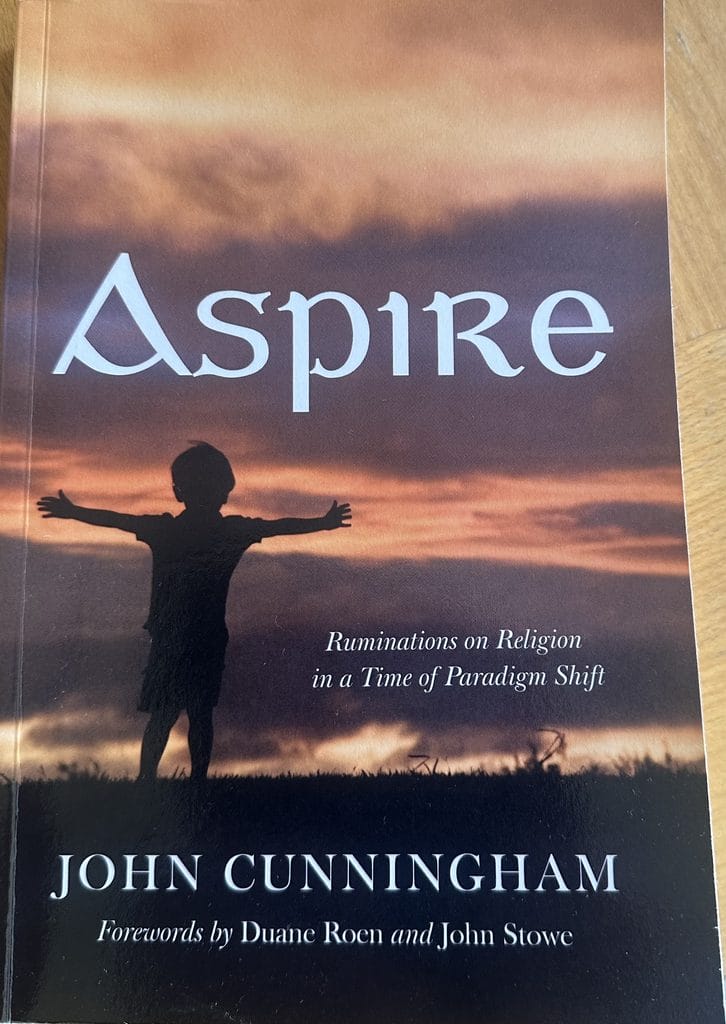
John Cunningham speaks about his new book Aspire
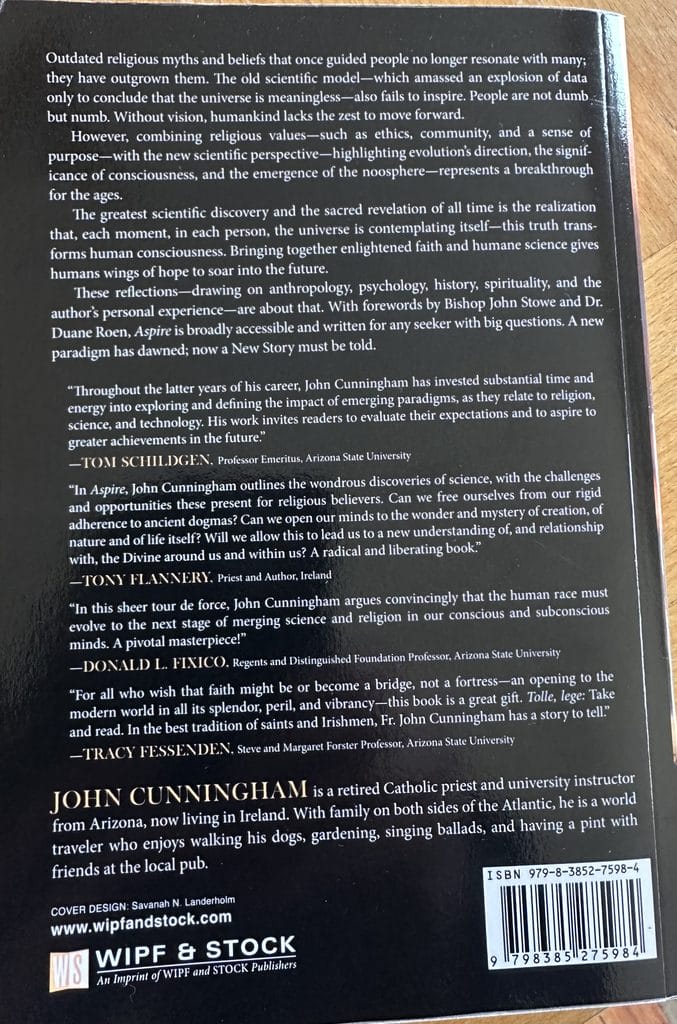
Retired US priest John Cunningham has just published his new book, Aspire. John is a member of the ACP and lives in Kiltimagh, Co Mayo, the home of his ancestors.
He was a guest on Midwest Radio’s Faith Alive programme with Monica Morley and Brendan Hoban.
His book is available on-line from Amazon on Kindle or paperback (https://www.amazon.co.uk/Aspire-Ruminations-Religion-Paradigm-Shift/dp/B0HC5J573X/ref=sr_1_1?dib=eyJ2IjoiMSJ9.n72oyOgTo4MDHrudo78g5g.axpr35MHgigZ6fV1NHEt77h2dyBLX5mu_XzHOIiQa8I&dib_tag=se&keywords=cunningham%2C+aspire&qid=1790593355&sr=8-1)
I appreciated the podcast with John Cunningham and Monica Morley.
When John was speaking about myth, a memory surfaced. Our son arrived home from first year high school upset. He was distraught after being told that something he believed deeply was not literally true, but a myth. I said something so SIMPLE that dissolved his confusion. “It’s raining cats and dogs!” Are there cats and dogs falling from the sky? No, he responded. I get it, he said with a relieved smile.
He attacks an easy target in focusing on Jesus walking on water, Jonah, Adam and Eve, Noah, Babel — i.e. the most obvious biblical fundamentalism. Let go our notion of God, he says — a sky-God, another caricature. What about such truths as 1. divine revelation, 2. the Incarnation and the divinity of Christ, 3. the Trinity, 4. salvation, 5. eternal life.
The emergent God that we aspire to — is it just poetry?
An updated version of the Nicene Creed — via another ecumenical council — surely a very exciting idea.
Keep the good things — like community and ethics — and let go of the divine, salvific Christ, downgraded to a prophet or sage? All those pesky antiscientific dogmas are whisked away be being declared merely symbolic. The best investment would be the religions most free of their burden — unitarianism, Judaism, nay, Islam, or better still an agnostic form of Buddhism.
Teilhard de Chardin would surely not be happy with this.
“Outdated religious myths and beliefs…”
This reminds me of Kevin Treston’s excellent book, “Who do you say I am?”
Tony Flannery recommended to me that I read this book after I read one of Tony’s essays, “The language of Doctrine” and I realised that I didn’t really know what was my understanding of the reality of the God that I say I believe in. I am so grateful to Tony for that recommendation.
Anyway, in Kevin’s book he maintains that “The danger for Christianity now is to persist in proclaiming a corpus of beliefs that are incoherent and incompatible with proven modern science and framed in pre-modern outmoded cosmology.”
This, I would think, probably applies doubly so to Catholic Christianity.