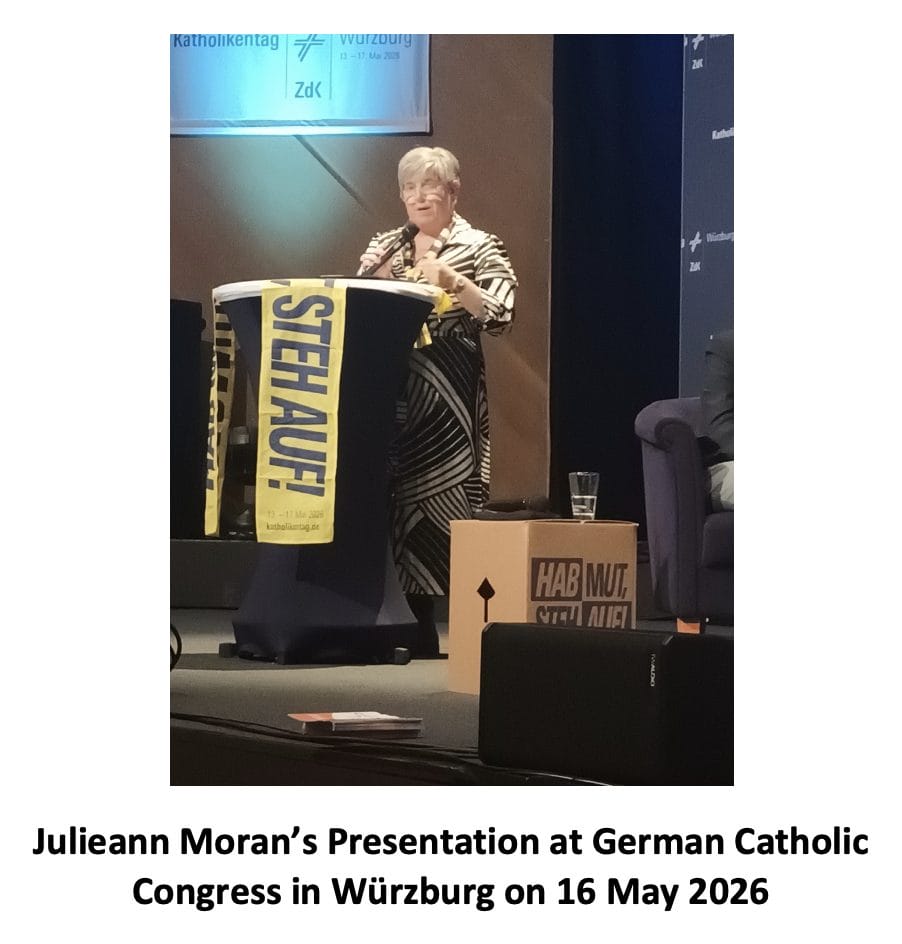
Julieann Moran at Katholikentag – Saturday Panel Discussion on Synodality 16/05/26
My first observation concerns how and who shapes the future. Cardinal Grech has reminded us that synodality is not simply a process or a programme but a way of being Church, rooted in baptism and in the conviction that the Holy Spirit speaks through the whole People of God.
We cannot understand ourselves as Church solely through structures and processes. We must understand ourselves through the grace of baptism, where each of us shares the same fundamental dignity and call to participate in Christ’s mission as priest, prophet and king.
That sounds theological, but it has very practical consequences.
It means that our future as the Body of Christ cannot be shaped by bishops alone. It cannot be shaped by clergy alone, and it certainly cannot be shaped by listening to the People of God and not allowing that listening to shape how existing patterns of governance and authority are exercised. If synodality is truly constitutive of the Church, it must shape not only how we listen and consult, but also how we discern, decide, and take responsibility together.
In Ireland, our own synodal journey has shown that people are willing to participate when they know they are genuinely being heard. Since 2021, we have been asking one simple but profound question: What does God want from the Church in Ireland at this time?
The answers we received were remarkably consistent. Three stand out for me in particular.
A Church where those who have often felt excluded are welcomed and not merely tolerated at the edges.
A Church where women’s gifts and leadership are recognised at every level.
A Church where those who have survived abuse are not treated as a problem to be managed but as teachers whose truth must be listened to and permitted to reshape us as the Body of Christ.
So my second observation is that synodality is not just about improving our internal structures. It’s about noticing who is missing, having the courage to ask why, and then changing in light of what we discover and in faithfulness to our tradition.
Cardinal Grech often speaks about “circularity” and “restitution.” This is essential. Listening matters deeply.
But people also want to know that their contributions bear real fruit. They need to see that their prayerful discernment travelled upward and outward across the Universal Church, and that something meaningful returned to them. They need to see that their sense of the faith (sensus fidei) matters; that their prayer, experience, and discernment genuinely shape the Church’s life and mission.
From my perspective, this is where a central tension emerges.
Some Church leaders have embraced synodality with sincerity and courage. But my experience also suggests that many remain hesitant, and some are openly resistant to synodality, especially when it is perceived as a threat to established patterns of authority.
Synodality does not diminish episcopal ministry or priestly ordination. It restores authority to its Gospel purpose of service rather than control, of discernment within the People of God rather than in isolation, and stewardship rather than possession. The question is not whether bishops or parish priests will lose power or authority in a synodal Church. Perhaps the deeper question is whether all of us, lay and ordained alike, are willing to let the Holy Spirit convert us.
In Acts chapter 10 Peter asks: “Who was I to think that I could stand in God’s way?” For me, this is at the heart of synodality and applies to all of us.
It applies when members of the faithful bring forward questions that arise from their experience of discipleship and baptismal dignity. When women ask whether the Church is fully receiving their gifts and leadership, when LGBTQ Catholics ask whether they truly belong, when divorced and re-married Catholics ask if they can receive Eucharist, when survivors of abuse ask for justice, accountability, and lasting reform.
I don’t believe these are threats to communion. They are signs that the Body of Christ is still seeking healing and integrity as it will to the end of time.
At the same time, authentic reform must be rooted in communion so synodality is not about factions winning. It is about the whole Body of Christ listening together for what “seems good to the Holy Spirit and to us (Acts 15)” where no voice is set against another but all are held within a shared act of discernment.
It seems to me that the Church has much to gain by listening deeply, and much to risk if, after listening, nothing changes. Synodality will only be credible if the voices of the People of God help shape not only what the Church says, but how the Church decides and acts. Its impact is already visible in the voices now being heard; and its future depends on whether local Churches have the courage to implement what they have learned.
Looking to the 2028 Assembly in Rome, I hope local Churches will bring more than carefully prepared reports, but the courage to speak with honesty, humility, and hope. Local initiatives will contribute practical experience, theological insight, and renewed missionary energy to the whole Church. But I hope we have the courage to tell the truth about what we have heard, about what is working and what is not; and where there is resistance and why. Because this seven-year pilgrimage that we will have been on together from 2021 – 2028 is not merely about changing structures. As the Final Document from the Synod reminds us, it’s about conversion. It’s about the Church becoming more fully what it is called to be.
My final observation is this. I believe the Holy Spirit is calling us beyond self-protection, beyond nostalgia, and beyond fear. The question before us, as the Body of Christ, is whether we are willing to follow. Will we cling to the familiar model that is not yet fully attuned to synodality, or embrace the journey of the Spirit and walk together as the People of God into the future that God is opening before us?