
Irish Times: ‘My proposal was to stop Confirmation’: Ireland’s ageing priests under pressure as numbers drop
Sat Sept 12 2026 – 06:00
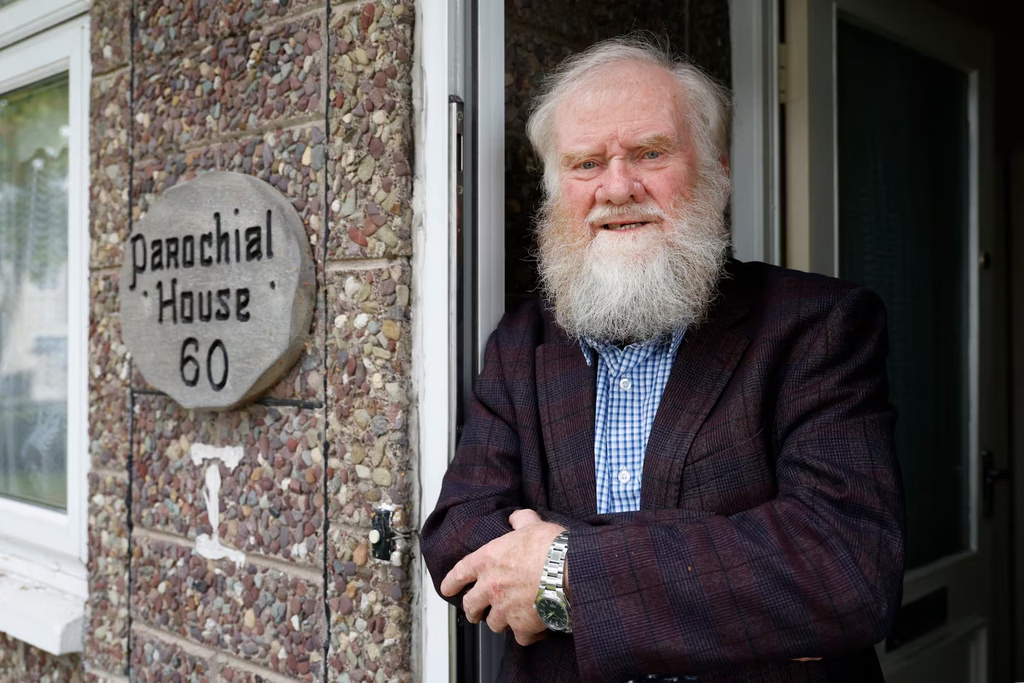
Fr Seamus Ahearne. Photograph: Nick Bradshaw
Fr Seamus Ahearne is turning 80 in November but shows no signs of slowing down and continues to serve in Greater Finglas Parish in north Dublin.
“We’ve not fully amalgamated the three parishes here,” he says, referring to the St Canice’s & St Margaret’s, The Annunciation and Rivermount parishes.
This means “about 70,000 people, with 22 schools and about 300 funerals in the year”.
Many of the 70,000 residents “would claim to be Catholic”, particularly when it comes to funerals, he says.
Four priests serve in the parish: Fr Richard Hyland (66) is parish priest, assisted by curate Canon Martin Hogan (75), curate Fr Michael Shiels (77) and Fr Ahearne (79), a “team assistant”.
Fr Eamon Cahill (81), retired parish priest of the Church of Annunciation and another “team assistant” in the parish, helps with a Mass at weekends, while parish chaplain and returned missionary Fr Frank Gallagher (78), a member of the Missionaries of the Sacred Heart order, “would come and do a weekend and do a funeral as well,” says Fr Ahearne.
“We work extremely well together. It’s a marvellous team. We rotate all the time.”
There are funerals every day: “There’s six funerals I’m dealing with at the moment,” says Fr Ahearne, noting he had “just came from three homes in the last few hours”.
“It’s the most privileged place to be: the stories and the honesty. The families are wonderful. We’re the ones who are used to doing it, so I say my job is to co-ordinate a kind of a scaffolding for the occasion,” he says.
The priest speaks of a new widow he met the previous day – “we buried her husband last Saturday” – and recalls sitting alone in the funeral home with the remains, preparing prayers when the woman entered.
“[She] started talking to her husband and, do you know what, it was beautiful, it was just so spontaneous,” he says.
“I felt I shouldn’t be there, this was too intimate, and then she started talking about him. That’s where holiness happens.”
Fr Ahearne says he will be 30 years in the parish next June. In his first few years in the parish, he handled 20 funerals resulting from murders.
“I’ve been through everything. I’m totally accepted in the homes,” he says.
There is a funeral team in the parish with plenty of work involved.
“They’re not sanctuary puppets,” he says.
“The thing about funerals, as people say to me – we have to be going to the houses, you have to make yourself known, just to be seen as a homely person, never mind all the formal stuff. People must feel comfortable – it’s our job.
“We know how to do the thing, how to carry it, you have to do that very gently,” he says.
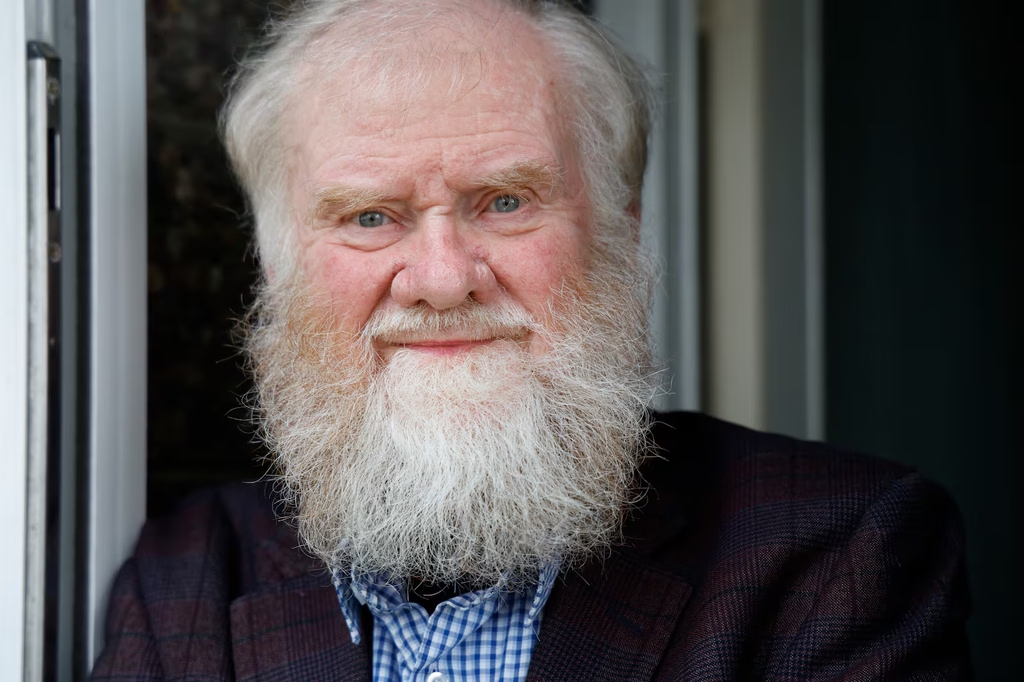
Fr Seamus Ahearne. Photograph: Nick Bradshaw
The decline in the numbers joining the priesthood means the prospect of there not being enough priests for funerals and other religious services is very real in Ireland.
Bishop of Kildare and Leighlin Denis Nulty warned last week that a shortage of priests could mean funerals, baptisms and weddings having to be led by lay people in parishes.
Nulty said in a pastoral letter he was “very conscious of the age profile of our priests, many of them serving parishes long beyond the acceptable retirement age in the secular world” and that “lay involvement” was one way to continue the work in parishes.
He noted how, of 45 priests who were past the retirement age of 75 in his diocese, 27 still held posts in parishes with 10 of them working as parish priests or administrators.
Other bishops have spoken about the issue.
Martin Hayes, Bishop of Clogher, which covers mainly Monaghan, said last month that just nine priests in his diocese, including foreign-born priests, were under 40, with almost half – 47 per cent – being over the age of 70.
Larry Duffy, Bishop of Kilmore, which covers mostly Cavan, said in recent weeks that 53 per cent of priests in his diocese were over 70, with just nine under 60.
Killala diocese in Mayo has just one priest under 50. Fr Brendan Hoban, who is based in the diocese, recently wrote how “it has been officially estimated that in six years’ time – in 2032 – there may be as few as six priests for the 22 parishes of the diocese.”
I just can’t believe that an old fellow of 80 is as young as I am and that I have the energy that I have
— Fr Ahearne
In Dublin, the statistics on the older age profile of priests are also stark.
Of 408 priests listed on the Archdiocese of Dublin website, 178 are retired, are not in service in Dublin, are “team assistants” – usually priests who have passed the retirement age of 75 but continue to serve in parishes – or are chaplains, most of whom are also over 75.
In addition, a significant number of priests listed as “curates” on the website carry the title “very reverend”, indicating they previously held senior positions in the church and are now serving in postretirement roles.
Of those priests under 75 and serving in Dublin, 67 are foreign-born priests.
The archdiocese’s financial statements for 2024, published last October, said it was served by 361 priests, most of whom were elderly. It projected the number of its priests would fall by 70 per cent within 20 years.
Its 195 parishes have been grouped into 53 partnerships, with priests – as in Greater Finglas Parish – now serving multiple parishes, and many of them appointed parish priest to more than one parish.
The work extends beyond parish tasks.
These priests must also serve Dublin’s 449 Catholic primary schools as well as 178 Catholic secondary schools, with an additional 45 secondary schools where the church is represented on the boards of management.
In Finglas, Fr Seamus Ahearne says when it comes to involving the laity in the work of the parish, it is “hard enough to get people who are suitable” to serve on funeral ministry teams.
“People go in and read the book, that’s fine, but who wants it? Who wants the ritual?” he says, noting that nowadays people are not accustomed to being in a church or at Mass.
He singles out one woman on the parish funeral ministry team who “could go into any home – she’s great, the people are at home with her, she’s at home with them.”
There are few church marriages in the parish these days.
However, he is “doing a convalidation” – where a Catholic couple married outside the church wants their marriage recognised by the church – this evening.
“At this stage in their lives, they wanted to celebrate their 10th anniversary by coming to church and having a ceremony in church,” he says.
With 22 schools, Communion and Confirmation are big events involving a huge amount of work. This morning Fr Ahearne attended a meeting to decide on dates for both.
“My proposal was [to] stop Confirmation completely; it doesn’t make any sense. I’m not being dismissive, but the work involved in the schools alone, it takes too much time,” he says.
To help, they have a faith formation person and, before that, a pastoral worker.
“They do great work with the schools. They carry some of this for us,” he says.
But, he says: “Don’t overwhelm, don’t mind all these meetings – be careful what we spend our time at.”
Finglas has a large immigrant community and Fr Ahearne says young immigrants such as Africans, Indians and Filipinos would “wear you out” with Confession as they adhere to a traditional 1950s Catholicism.
“It’s lovely to see that kind of faith – it’s devotional – but the general population would have no interest in that kind of stuff at all,” he says.
Fr Ahearne says he is tired, but still has the energy to keep going.
“I just can’t believe that an old fellow of 80 is as young as I am and that I have the energy that I have,” he says, noting that he never takes days off.
“It’s the kind of person I am.”
He believes this is probably more rooted in personality than vocation.
“I just love what I do. I enjoy it. I meet all kinds of issues, and problems, and homes and families.
“To be able to do that is just wonderful.”
An Augustinian priest, Fr Ahearne served 20 years in the UK, where he was also provincial for a time, before coming to Finglas. He says he knows Pope Leo XIV, or “Bob” as he refers to the fellow Augustinian Robert Francis Prevost.
“He’s a lovely man. I wrote to him when he was elected and I said: ‘Bob, I just didn’t want you getting this role.’ I said: ‘You’re almost too good for it.’”
In addition to all his work in the Finglas parish, Fr Ahearne is also on the leadership team of the Augustinians in Ireland. He is unfazed by his overall workload.
“I’ll keep going as long as I can,” he says.
I agree with Seamus that confirmation could be stopped.
Passive reception of the Sacraments which over emphasize the priest’s power and neglect the internal spiritual commitment for the recipient have contributed to the crisis in our church today. We have overburdened Priests and neglected the spiritual formation and contributions of the laity. Synodality will work to overcome these concerns.
All priests need to retire at 75.
The best that elderly priests can do is train lay people, invite them to shadow them and learn.
Lay people can lead funeral rites, including the funeral service.
Give lay people full agency.
We have not built up the laity for co-responsibility, the result is the system is stuck.
As for Confirmation we have been dancing around changing it for at least 30 years.
It’s a sacrament of exit.
Radical change is needed.
By this stage lay people should have full charge of some parishes as provided for in canon 512.2.
There was a song entitled ‘letting go is hard to do’.
Fr. Seamus your Article is rather moving. Clearly you are a man committed to the Service of your Parishioners.
As a layman with several Chronic health conditions, I find myself admitted to Hospital yet again, this time with a Malaria related issue. I spent many years in Senegal as an Engineer but unfortunately caught Malaria.
That said, Senegal was part of French Speaking West Africa evangelized by Archbishop Marcel Lefebvre under his Holiness Pius XII. The Tridentine Mass was readily accessible when I worked there.
As someone baptized in 1968 in Westminster Cathedral and brought up in Reading and subsequently in Bray, I attended Traditional Latin Masses as a Kid. In the 1970s, these Masses were underground, Recusant style!
The Priests who looked after me then, still do do today. I refer of course to the SSPX. Everyday since my admission last Wednesday, an SSPX Priest has visited me. Yes, I am excommunicated for formally adhering to the Schism of July 1st this year.
But I am full of hope. My prayer life is uncomplicated. The Tridentine Mass when health permits, and of course the Rosary.
I see so many of my contemporaries performing mental gymnastics to convince themselves that Synodality is of the Holy Ghost. Whereas, I believe and pray as our forefathers did. I am at Peace because I have been given the gift of believing the perennial binding public revelation of the Church and rejecting documents like Fiducia Supplicans, which uses Nominalism to undermine revealed truth.
The SSPX Priest who visited me this morning at 10.00, was ordained in 2025. I’d put him about the 35 Mark. The Average age of SSPX Clergy is 46. Younger than me! That gives me hope.
Bishop Cullinan should eat humble pie and as the Hierarchy Vocations man, investigate why SSPX Seminaries have waiting lists! I believe the Unchanging Holy Ghost is possibly trying to tell us Something.
Seamus, I wish you Ad Multos Annos!
The many foreign-born priests have altered dramatically the character and quality of Irish diocesan life for both clergy and laity. How are we embracing their culture and dialoguing with them? We cannot pretend that the old saggart aroon of beloved memory is ruling the roost. A cosmopolitan and multiethnic community of men is now the Irish presbyterate. This is a very new and very modern situation, demanding a new way of thinking. Is it surrounded by silence? Are the priests in question encouraged to share their African, Asian, or East European culture with their Irish colleagues and flock?
The foreign-born priests I have spoken with say they plan to return home in the future. May this interlude be a happy memory for them.
Confirmation: A catholic Bishop gave a talk to future confirmation candidates.
To my ears the theme of his talk was will power. Research on will power is less than encouraging. “Will power gets exhausted from effort and it is a limited cognitive resource.” It was mentioned that meditation improves will power skills.
Young people need more than will power to refrain from drugs and alcohol today as was encouraged by the Bishop.
Cardinal Mercier left us his Prayer to the Holy Spirit. Confirmation is a perfect time to present it to the candidates. It gives real hope, a Presence that will always be with you. This presence makes will-power possible. The prayer requires a personal response!
“Sacramentalised but not evangelised” sums up the deepest problem of the Augustinian Christendom church – with ordination summitting the sacramental batch processing system – and the normal pattern of spiritual development – as well as the Kingdom of God – almost completely lost to view.
On the other hand that pattern remains obvious both in the Gospels and the history of the church – the coincidence of the deepest conversion not with any programmed ritual but with adult life crisis, the perfectly natural ‘mid life’ culmination of youthful optimism and egotism. It is that point that readiness for baptism, a ritualisation of rescue from drowning – and the conscious experience of entry to the Kingdom of God – is at its greatest.
This, surely, is why the baptising of children never occurs in scripture, and why the disgracing of the church’s governing system has undermined its sacramental system also. The illusion that sacramental progression – begun with infant baptism, and programmed for everyone from then on – must also be spiritual progression has been totally shattered.
It was left for two Baptists to recover the full meaning of adult conversion in the AA programme, for any addiction is surely the adult experience of drowning that Baptism then fully explains and copes with. The deepest experience of the Kingdom of God includes the realisation that we are all loved by God as we are, and that social ‘success’ (and ‘failure’) are a meaningless mirage.
It is not just the timing of Confirmation therefore that needs to be rethought. The entire sacramental system as we know it results from the co-opting of the church by the state and the use of sacraments to solidify a social and political hierarchy. The misunderstanding of John 3:5 initiated by St Augustine of Hippo – referring as that passage clearly does to an experience of the kingdom of God that is only possible in adulthood – needs to be acknowledged.
Given the ongoing acceleration of an unprecedented global existential crisis – evidenced by AI, by weapons in space and by terrifying summer temperatures – there can be no shortage of adult life crises anywhere. The church’s sacramental system – and its pastoral theology – needs to be reorganised to cope, learning from what the 12-step response to all addictions is so obviously teaching us.
I say AMEN to your comment Sean.
James Fowler’s “Stages of Faith” indicates that youth ages 13-18 have the ability for abstract thought marking the stage where a deliberate internalized commitment to a belief system occurs.
“It is highly possible and developmentally typical for a young person between ages of 13 and 18 to make a genuine, personal commitment to a religious belief.”
My hope would be that Catholic young people are provided the opportunity and the information to make this commitment possible. We should lead them to the water.
Some may drink!
I recommend the Australian horror movie Leviticus, which I saw in the Irish Film Institute on Eustace St. today. It points to the horror of the mental confusion church doctrine on sexual orientation has imposed on teenagers for long centuries. Claude.com says:
The setup: Two gay teenage boys, Naim and Ryan, fall for each other in a small, deeply religious Australian town. When their families discover the relationship, the boys are subjected to a church “deliverance” — essentially conversion therapy staged as an exorcism. Reviewers describe it as a haunting metaphor for gay conversion therapy.
The horror comes not from the boys’ desire for each other, but from the community’s attempt to destroy it. The film expresses the violence of queer repression and conversion therapy through a literal curse, following gay teenagers targeted by a demonic entity that appears as the object of their desire.
The director is leaning into the idea that repressing who you are does real harm — the demon literally takes the form of your crush, weaponizing lust that the church tried to forbid.
The true “monsters” aren’t supernatural. They’re the adults — parents, caregivers, friends — who turn on vulnerable, scared young men and make them frightened of each other. One review notes a mother who’ll pick disliked toppings off her son’s pizza but won’t accept him kissing another boy — showing conditional, shallow “love” that fails at the moment it matters most.
Rather than framing gay desire as sinful or dangerous in itself, the film frames the shame and repression forced onto it as the actual source of suffering. One critic put it directly: Leviticus perfectly captures the horror of homophobia, with gayness as the driving emotional force of the story rather than incidental.
Séan@6, “ Sacramentalised but not evangelised”. Now, Séan, that really hits the nail on the head.
In Tomáš Halik’s recent book, The Afternoon of Christianity, he refers to an African theologian who maintains that it is a fallacy to believe that the church in the Third World is growing just because there may be multitudes being baptised because it does not follow that they go on to practice their faith.
Joe@8, during Covid there were a number of excellent Zoom lectures on this site.
One of them was given by Fr. James Alison who received that phone call from Pope Francis.
James explained in detail how a misreading of Leviticus has led to Christianity’s, indeed humanity’s, misunderstanding of homosexuality and the subsequent evil of homophobia.
When I engage with homophobes I often wish I could remember exactly what Fr. James said.
Couid you enlighten me again, Joe?
Even though you may not have heard James’ talk I expect you could explain the misunderstanding of Leviticus just as well as he did.
Paddy, This is the link to the audio of Fr James Alison’s ACP Zoom from April 2021
https://soundcloud.com/user-211747038/james-alison-tues-27-april-2021-audio
Is it not just time to accept the end of this era of “Catholic” control of society and hand back the schools to the people of Ireland? A bunch of tired elderly old men mired in scandals despite any good intentions on the part of an individual are really an anachronism at this stage and just a shadow of an age and time long over.
We can change who sits in school seats but we can’t change who we are.
Who are “the tired elderly old men” that you carry in your flesh? Our physical connection to our ancestors is real and LITERAL through our DNA, cellular makeup and evolutionary biology. Today, the past becomes the present as we carry forth in our flesh those who have gone before us. Today, in the present, we can choose to benefit from the wisdom of the elderly or we can choose to think their time has past.
(For whom does the bell toll?}
Seamus, I thought your honesty in that Irish Times article was brilliant especially this bit;
“Finglas has a large immigrant community and Fr Ahearne says young immigrants such as Africans, Indians and Filipinos would “wear you out” with Confession as they adhere to a traditional 1950s Catholicism.”
Someone has to say these things.
The reason we admired and loved Kieran so much was his integrity and honesty in speaking his truth and we love you too, Seamus.
Joe @4
“How are we embracing their culture and dialoguing with them? “
Joe, the more pertinent question is are they imbracing our culture? The majority of them seem unwilling to do so.
That and the fact it is so difficult to actually understand what they are saying to us.
Am I correct in thinking that at home in Ireland there’s an acceptance that it just doesn’t work?
Scottish laity realises this too, though I haven’t heard this from our leaders.