
NCROnline: A Catholic solution to gender bias in AI
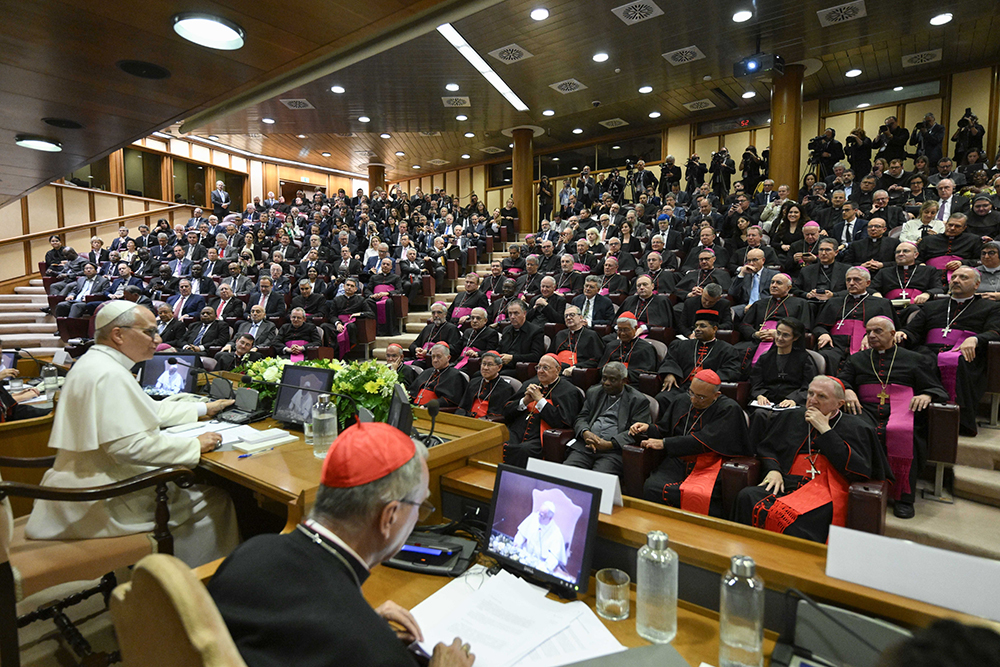
Pope Leo XIV attends the presentation of “Magnifica Humanitas” at the Vatican’s Synod Hall May 25, 2026, the first encyclical of his papacy, which focuses on the rise of artificial intelligence. (OSV News/Vatican Media/Simone Risoluti)

by Phyllis Zagano
Follow on Twitter at @phylliszagano
Join the Conversation
Send your thoughts to Letters to the Editor. Learn more
June 1, 2026
The widespread analyses of Pope Leo XIV’s encyclical, Magnifica Humanitas, overlook one thing: Artificial intelligence is inherently male.
Most people think of AI as a tool to summarize information through what are called large language models. The problem: LLMs are trained by men, and most of the data and information available has been created by men. Most of the programmers teaching AI to “think” are men. So, AI decision-making and prediction behaviors are essentially male.
No wonder the pope has called for “disarmament” of AI. Men go to war.
The world is a mess. Can AI help?
Maybe yes. Maybe no.
These are Leo’s answers in Magnifica Humanitas, which he released on May 25 along with three cardinals, two female professors and Christopher Olah, co-founder of the AI giant Anthropic.
Olah specializes in reverse engineering neural networks at Anthropic. That means he looks inside the machine, as it were, trying to understand how it learns, how it “thinks,” how it makes decisions. But almost everything he studies comes from the male point of view.
The male viewpoint dominates AI answers, AI algorithms, AI predictions and AI decisions from start to finish.
Would “gender-neutral” be any better?
No.
If the trainers aim for complete removal of gender, if gender drops from the equation, and everything entered into AI machines is nonbinary, AI’s responses and decisions are still likely male-oriented, since the general default in language is male.
So, is there a solution? Where can it be found?
Suggestion: synodality and synodal reciprocity. “Reciprocity” is a word threaded throughout the final document of the years-long (and continuing) Synod on Synodality, begun by Pope Francis in 2021. Reciprocity requires the views of males and of females to be positively, if not equally, considered. It is a matter of epistemology — of how we know and understand. Humans are gendered, embodied beings and possess different outlooks. Reciprocity attempts to merge the outlooks. The concept of “reciprocity” denies the epistemological error that sees the male and female as existing and defined only in opposition to each other. It also argues that the combination of viewpoints is more likely to arrive at a balanced answer to whatever question arises.
Can synodality survive in the Catholic Church, and can AI be useful, when both the church and AI default to a male point of view? If the search is for truth, only reciprocity can produce balanced, some would argue correct, questions and answers.
As the American poet E.E. Cummings once wrote, “Always the more beautiful answer, who asks the more beautiful question.”
Leo is asking the right questions. He wrote, “when AI systems present themselves as neutral and objective, they end up reflecting and reinforcing the stereotypes or ideological bias of their designers and developers.”
One can only hope that the views of women will be added to the equation.
This story appears in the AI Encyclical: Magnifica Humanitas feature series. View the full series.