Seán Ó’Conaill: No Humility Without Humiliation

“We should, therefore, look to the Gospels to outline for us the journey of conversion we are required to undertake, learning little by little to make Jesus’ practices our own.”
This is just one of twenty-four references to ‘conversion’ in the Final Report of the 16th Synod on Synodality. Called to conversion by the Holy Spirit, we learn that the whole church is now to undertake a continuous conversion of relationships, of processes and of bonds.
But if ‘conversion’ is something that happens whenever we ‘undertake’ it, how come the bishops of the church were not converted to effective child protection in the church until – beginning about 1985 – victims of childhood clerical abuse – aided by secular police, lawyers, courts and media – showed us that instead bishops globally were endangering children by hiding the problem – and that this was standard procedure, mandated by the church at the highest level?
The fact that the magisterial church was converted to child protection – and then to synodality – only by this totally unexpected public relations disaster is nowhere acknowledged in this final report of the 16th Synod of 2024 – and this alone tells us that the magisterial church still has ‘ways to go’ on the conversion journey if it is to lead the rest of us convincingly.
Charged now with understanding ‘Mission’ and ‘Adult Faith Formation’, every diocese in Ireland would be wise to ask what exactly went wrong with the faith formation model we inherited.
The Great Mistake
Would we not be wise to consider the possibility that the root of the problem was a tendency to think of adult Christian faith as programmable to begin with – never questioning that schooling and seminary training, topped by the sacrament of ordination, would signify complete Christian conversion?
That these might well signify merely conversion to Catholic institutional careerism and conformity – as revealed by the disasters still ongoing – has still not been acknowledged by that same institution.
Was any great saint of the church ever converted to their mature adult faith by any formal faith formation programme, beginning in childhood? Peter, to begin with, spent three whole years with the greatest teacher ever – and was then fully converted only by the humiliating experience of his own tragic weakness when faced with the hostile crowd, and then Jesus’ forgiveness. Paul was converted – we are told – by the shocking intervention of the Lord himself, from Heaven, on the road to Damascus to root out the Christians there.
Augustine of Hippo in the late 4th century had to confront the reality of his own adult dissolution and confusion before faith could truly set in. Patrick of Ireland was converted by an entirely unplanned experience of kidnapping and slavery, while Columba of Ulster had to experience the violence caused by his own ecclesiastical ambition and rivalry with St Finnian.

Pope Francis – also transformed by adult failure
Isn’t there a discernible pattern in all of these stories – of mature adult Christian faith arising out of unexpected humiliation rather than any early deliberate early life formation programme? Didn’t that pattern hold true for Francis of Assisi, Ignatius of Loyola, Alphonsus Liguori, Therese of Lisieux, Maximilian Kolbe, Franz Jagerstatter – and Pope Francis?
Doesn’t the entire history of the church – underlined now especially by the hierarchical disaster we are undergoing – tell us that the deepest Christian faith is arrived at only by the unplanned experience of personal life crisis and powerlessness – the necessary downfall of youthful egotism – not by any faith formation programme received in relative tranquillity?
Didn’t Pope Francis put this best: “There is no humility without humiliation!”
Ordination is Not Conversion
If the church had always understood and taught this – that faith formation is always tested – and completed – ONLY by unwanted and unplannable adult setback – and that ordination and conversion are NOT the same thing – would there ever have been even a reason for secrecy over clerical child sexual abuse?
Was it not the vain belief that faith can be fully formed by school and seminary programmes that led to the mystique of clergy – the clericalism – that produced Crimen Sollicitationis in 1962 – the binding of all Catholic bishops to strict secrecy on clerical sexual abuse of minors?
This is not to argue that we do not need formation and early sacraments: both are essential if we are to interpret correctly the meaning of adult setback. The mistake is to believe that conversion is achieved if we simply ‘undertake’ it – and then complete the set course.
If there is indeed no humility without humiliation isn’t that also the explanation of the church catastrophe we are living through? Don’t we now need this insight – this warning – to be woven deeply into all of our formation programmes, to counteract the pride and naivety that can all too easily result from simply completing the programme?
Shouldn’t the church already be teaching us, explicitly, that formation and ordination are not conversion?
The Pattern of Spiritual Development
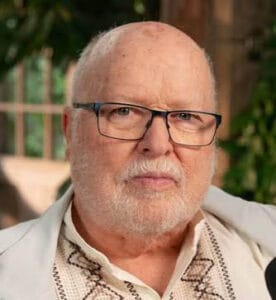
Richard Rohr OFM
For decades the contemplative Richard Rohr OFM has been teaching of the necessary experience of suffering to take us from the first half of life into the second. He defines suffering as a deep experience of complete powerlessness. Don’t we now need to understand this as humiliation, the necessary adult downfall of early egotism that cannot be programmed?
It isn’t only the church that is undergoing humiliation just now. So is the secular enlightenment, confronted by the environmental consequences of three centuries of exploitation of fossil fuel energy, as well as the real danger of nuclear self-annihilation. Hubris still counsels an onward march to ‘artificial intelligence’ but wisdom warns that pride always comes before a fall – and that the true future of humankind will be arrived at only by humiliation – and humility – first of all.
There is no escaping the disaster course that youthful pride and egotism always have in store for us humans, so how did the Catholic magisterium come to publish in 2011 a Youth Catechism – YouCat – which did not even index that word ‘pride’, giving copious examples? Will we ever hear this explained in homilies on Jesus’ question about the beam in one’s own eye that leads us to complain about the motes in the eyes of others?
Nothing could be clearer than the truth of Lord John Acton’s pithy sentence of 1887, in a letter insisting that even bishops and popes could be corrupted by power. “There is no worse heresy than that the office sanctifies the holder of it.”
We are surely being trained – by the humiliation of the church – to see humbled pride as the pattern of historical human development also. Ongoing ecclesiastical and secular failures are the indispensable God-given formation and conversion course that we could never ourselves have planned.
Sean O’Conaill
12th July, 2026
St Bernadette Soubirous: “It takes many humiliations to make humility.”
Karl Rahner: “There is no humble person who has not something to be humble about.”
Leo XIV, in his encyclical, strikingly apologizes for the church’s entanglement in slavery all the way up to Leo XIII, something that apologists like Avery Dulles (whose Jesuit university owned slaves) covered up.
Vatican II’s Declarations, Dignitatis Humanae and Nostra Aetate contradict millennia of malpractice against the Jew and against religious freedom, but with no acknowledgement of conversion or repentance (that had to wait for John Paul II’s “purification of memory”).
The Vatican’s timid steps to welcoming lgbt folk is not accompanied by any acknowledgement of conversion or repentance.
I would say that we were all educated in pride, not humility, when we internalized slogans such as: “The Church has never erred”, “The Roman Church alone possesses the fulness of Truth”; “The plurality of religions exists de facto, but not de iure”; “No salvation outside the Church”.
Or consider the Syllabus of Errors of 1864:
CONDEMNED: 15. Every man is free to embrace and profess that religion which, guided by the light of reason, he shall consider true. — Allocution “Maxima quidem,” June 9, 1862; Damnatio “Multiplices inter,” June 10, 1851.
16. Man may, in the observance of any religion whatever, find the way of eternal salvation, and arrive at eternal salvation. — Encyclical “Qui pluribus,” Nov. 9, 1846.
17. Good hope at least is to be entertained of the eternal salvation of all those who are not at all in the true Church of Christ. — Encyclical “Quanto conficiamur,” Aug. 10, 1863, etc.
18. Protestantism is nothing more than another form of the same true Christian religion, in which form it is given to please God equally as in the Catholic Church. — Encyclical “Noscitis,” Dec. 8, 1849.
19. The Church is not a true and perfect society, entirely free- nor is she endowed with proper and perpetual rights of her own, conferred upon her by her Divine Founder; but it appertains to the civil power to define what are the rights of the Church, and the limits within which she may exercise those rights. — Allocution “Singulari quadam,&quuot; Dec. 9, 1854, etc.
20. The ecclesiastical power ought not to exercise its authority without the permission and assent of the civil government. — Allocution “Meminit unusquisque,” Sept. 30, 1861. [This thinking is what underlay the idea that the civil power has no authority over the clergy — which led to the excommunication of Venice in 1605 for its refusal to hand over two clerics guilty of sexual crimes to the church for trial.]
26. The Church has no innate and legitimate right of acquiring and possessing property. — Allocution “Nunquam fore,” Dec. 15, 1856; Encyclical “Incredibili,” Sept. 7, 1863. [It was also reproached to Venice that it set limits to the church buying up land.]
30. The immunity of the Church and of ecclesiastical persons derived its origin from civil law. — Damnatio “Multiplices inter,” June 10, 1851.
31. The ecclesiastical forum or tribunal for the temporal causes, whether civil or criminal, of clerics, ought by all means to be abolished, even without consulting and against the protest of the Holy See. — Allocution “Nunquam fore,” Dec. 15, 1856; Allocution “Acerbissimum,” Sept. 27, 1852.
32. The personal immunity by which clerics are exonerated from military conscription and service in the army may be abolished without violation either of natural right or equity. Its abolition is called for by civil progress, especially in a society framed on the model of a liberal government. — Letter to the Bishop of Monreale “Singularis nobisque,” Sept. 29, 1864.
55. The Church ought to be separated from the State, and the State from the Church. — Allocution “Acerbissimum,” Sept. 27, 1852.
76. The abolition of the temporal power of which the Apostolic See is possessed would contribute in the greatest degree to the liberty and prosperity of the Church. — Allocutions “Quibus quantisque,” April 20, 1849, “Si semper antea,” May 20, 1850.
77. In the present day it is no longer expedient that the Catholic religion should be held as the only religion of the State, to the exclusion of all other forms of worship. — Allocution “Nemo vestrum,” July 26, 1855.
78. Hence it has been wisely decided by law, in some Catholic countries, that persons coming to reside therein shall enjoy the public exercise of their own peculiar worship. — Allocution “Acerbissimum,” Sept. 27, 1852.
79. Moreover, it is false that the civil liberty of every form of worship, and the full power, given to all, of overtly and publicly manifesting any opinions whatsoever and thoughts, conduce more easily to corrupt the morals and minds of the people, and to propagate the pest of indifferentism. — Allocution “Nunquam fore,” Dec. 15, 1856.
80. The Roman Pontiff can, and ought to, reconcile himself, and come to terms with progress, liberalism and modern civilization.- -Allocution “Jamdudum cernimus,” March 18, 1861.
Is there any official account of what to make of these condemnations today? Or do we just count on them to remain a dead letter? The 1976 edition of Denzinger has a prefatory note: “It is clear that some of these propositions, of a more juridical or church-political bearing, depend greatly on the conditions of that time.” Nothing about hubris, conversion, repentance, or purification of memory.
Claude.com says: 1. Since Vatican II’s Dignitatis Humanae (1965) affirmed religious liberty — seemingly contradicting the Syllabus’s condemnation of the proposition that states shouldn’t establish Catholicism exclusively — a major strand of post-conciliar Catholic scholarship (associated with thinkers like Basile Valuet and, in different ways, Cardinal Ratzinger and John Courtney Murray earlier) has argued there’s no real rupture. The claim is that Pius IX was condemning a specific 19th-century ideological liberalism (the Enlightenment claim that truth is whatever reason decides, indifferentism, and the notion the Church has no rights the state must respect) rather than religious liberty as such, and that Vatican II operated in a different register — prudential/pastoral rather than dogmatic. This reading treats the Syllabus as historically contingent polemic, not a timeless doctrinal wall, and is largely how the Vatican itself now frames it.
2. For groups like the Society of St. Pius X, Vatican II’s teaching on religious liberty does contradict the Syllabus and Quanta Cura, and later theologians are retroactively softening Pius IX to paper over a real doctrinal reversal.
3. Historians have noted that Pius IX issued the document while Rome was encircled by enemies, having suffered humiliation and losses to the new Italian state under Mazzini and Cavour, and read the Syllabus partly as a reaction to those political tormentors rather than a pure theological statement. On this reading, the Syllabus’s harshness owes as much to Pius IX’s personal and institutional crisis as to considered theology. The French bishop Dupanloup tried to blunt the Syllabus’s impact in an 1865 pamphlet by reframing it as a description of an unattainable “perfect society” ideal, not a practical political program — essentially the first attempt to relativize the document, which modern “hermeneutic of continuity” scholars echo in more sophisticated form.
4. A more academic-historical approach treats the Syllabus less as a coherent argument and more as a symptom of ultramontanism’s peak — useful for understanding 19th-century Catholic identity politics, the run-up to papal infallibility (1870), and Church-state conflicts (Kulturkampf, the Roman Question) rather than as a text to be philosophically parsed proposition-by-proposition.
Thank you Sean and Joe too.
Absolutely excellent as usual.
I hope to comment once I have read it again in the morning.
Sean, you write “He defines suffering as a deep experience of complete powerlessness.” We give thanks to the founders of A.A. for leaving a program with the ability to transform the helplessness of the alcoholic into a person focused on the Divine for their sustenance.
Yes indeed M G-B. And more than once Richard has referenced AA as where the real spiritual work is being done these days, often in church basements. One of his most widely used books is “Breathing Under Water: Spirituality and the Twelve Steps” – it’s used even by those without a recognised addiction, because for Richard ‘sin’ can even be understood as addiction e.g. to work and ‘career’, the hopeless quest of validation in ‘positive feedback’ from others. Often, he argues, popular religious devotionalism is superficial in comparison to what happens at AA meetings – where the ‘false self’ is unmasked.